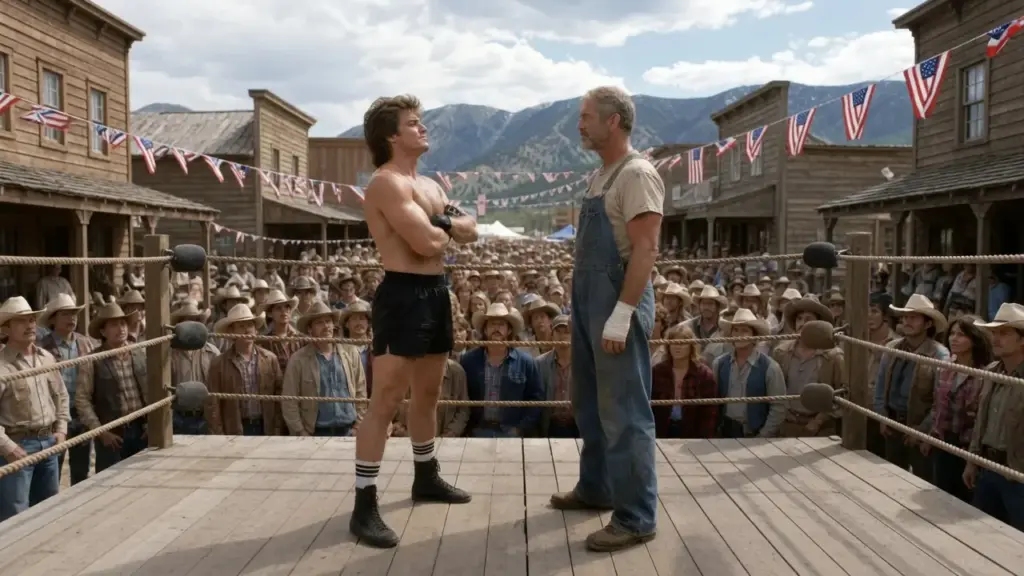
He wore the same faded Wrangler jeans he wore to fix the fence, paired with a plain gray cotton T-shirt. He carried a roll of standard white athletic tape in his left hand. No gym bag, no entourage, no music. The crowd parted for him differently than they had for Weston. They didn’t cheer.
They just fell silent. The locals had known Arthur for 20 years, but none of them actually knew him. He bought his feed, paid his taxes, and minded his business. Seeing him walking toward the lights, his face cast in stone, made people uncomfortable. They felt like they were watching a man walk to the gallows.
Sheriff Miller, a heavy-set man with a gray mustache who had reluctantly agreed to referee the bout, met Arthur at the edge of the platform. Arthur, Miller said, his voice low, troubled. You don’t have to do this. I can shut this down right now. Call it a hazard.
I know what he threatened regarding your property. We can fight that in court. Arthur stopped at the base of the wooden stairs. He looked up at the ring. Weston was pacing like a caged tiger, glaring down at him, pounding his four-ounce MMA gloves together. Court takes years, Sheriff, Arthur said flatly.
This takes three rounds. Arthur walked up the steps and ducked between the ropes. The canvas was soft under his boots. He hadn’t taken his boots off. Weston laughed out loud, pointing across the ring. You’re fighting in shit-kickers?
Are you insane, old man? I’m going to break your legs. Arthur didn’t answer. He walked to his corner. There was no stool. He just stood facing the center of the ring, unspooling the athletic tape.
He wrapped his hands himself. It was a slow, methodical process. Figure eight around the knuckles, lock the thumb, anchor the wrist. The movements were so deeply ingrained in his muscle memory that his eyes never left Weston. Arthur’s gaze was empty.
The lights, the noise, the crowd, none of it registered. He was descending into a very dark, very quiet room in his mind. He was unlocking a door he had welded shut in a desert two decades ago. Sheriff Miller called them to the center of the ring. Weston marched forward, his chest puffed out, refusing to touch gloves.
He glared down at Arthur, trying to find a flicker of fear. He found nothing, just a void. Standard amateur rules! Miller yelled over the noise of the crowd. No illegal strikes and no deliberate attempts to cause lasting injury. Protect yourselves at all times.
You obey my commands. Understood? Understood. Weston barked. Arthur gave a slow, barely perceptible nod. Miller stepped back. He raised his hand.
The crowd went dead silent. Only the hum of the diesel generator and the snap of the moths hitting the halogen bulbs remained. Fight! Miller dropped his hand. Weston moved first, exploding across the canvas with all the speed and confidence his years of training had given him. He expected Arthur to retreat, to cover up, or at least to react like a man overwhelmed by the spectacle. Arthur did none of those things.
He stepped into the attack before Weston could build momentum and stopped him with a compact counter that drove the younger man backward and emptied the confidence from his face. The crowd reacted with one collective gasp. Weston had entered the ring expecting to perform. Instead, he had been interrupted so completely that, for the first time that night, he looked uncertain. He tried to recover by rushing forward again, throwing a wider and angrier attack.
Arthur avoided it with the smallest possible movement, caught Weston off balance, and brought him down hard enough to shake the plywood platform. Weston had spent years learning how to dominate controlled matches. Arthur moved like a man whose training had been built for survival rather than trophies. He wasted nothing. Every shift of weight had a purpose, and every response denied Weston the space he needed to regain control.
Within seconds, the younger fighter found himself trapped beneath a pressure he could not escape, his technique failing against someone who seemed to understand each attempt before he made it. One of Weston’s cornermen shouted for the referee to intervene. Weston struggled harder, increasingly frantic as the reality of the situation settled over him. He had mocked Arthur’s age, his clothes, his ranch, and his silence. Now he understood that the silence had never been weakness.
It had been restraint. Arthur looked down at him without triumph. There was no pleasure in his face and no anger that the crowd could recognize. His breathing remained slow, but his eyes carried the cold concentration of a man confronting a part of himself he had spent years trying to bury. Weston’s fear sharpened.
He stopped seeing a broken-down cowboy and finally saw a veteran who had survived places far more dangerous than a charity ring beneath festival lights.
You want to pave my road? Arthur asked quietly. Weston tried to answer, but his breath came too quickly and his strength was fading. You think money makes you dangerous? You think a belt gives you the right to threaten people? Arthur’s voice never rose. The calmness of it frightened Weston more than shouting would have. Weston slapped the canvas in surrender.
Arthur felt the old instinct inside him urging him to hold on, to make the lesson permanent, but he released the pressure at once and stood. That act of stopping cost him more than the takedown had. He backed away three steps, hands open, giving the referee room. Weston rolled onto his side, coughing and dragging air into his lungs. The arrogance that had carried him into the ring was gone.





