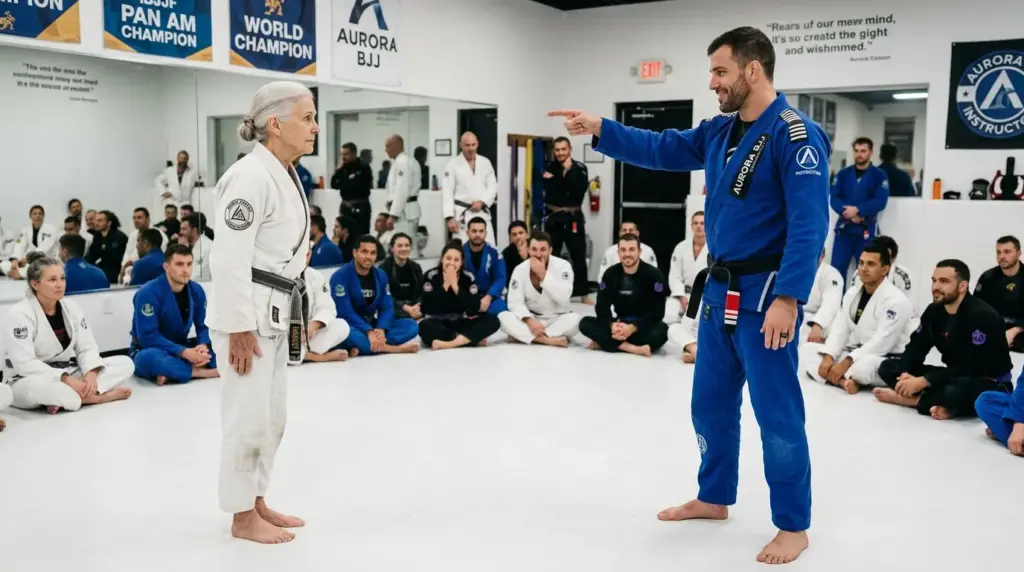
Edith’s expression did not change. “I understand your concern. But I assure you, I can manage.”
A blue belt called from the back, “Can you even get up from the ground without help?”
The class laughed again.
Jackson raised one hand, pretending to quiet them, though his own amusement was obvious.
“What belt do you claim to be?” he asked, emphasizing the word claim as if it were part of the joke.
“I don’t claim anything,” Edith said. “I earned my second-degree black belt under Master Hiroshi Takahashi in 1995.”
The name meant nothing to most of the students, but Coach Jackson’s expression changed for half a second. Takahashi was not famous in the flashy modern way, but among serious old-school practitioners, his name carried weight.
Jackson recovered quickly.
“I’m sure standards were different back then,” he said. “Why don’t you observe from the visitors’ area today? That might help you decide if this is really suitable for someone with your… experience.”
The dismissal was clear. The polite wording could not hide the insult beneath it.
But Edith Simmons had not spent forty-four years on the mat just to be sent to a chair by a man who had judged her before seeing her move.
“I didn’t come to watch,” Edith said.
Her voice was not loud, but it carried.
“I came to train.”
The room fell quiet.
Jackson’s smile faltered. He had not expected pushback.
“Ma’am,” he said, in a tone meant for children and stubborn customers, “we have insurance regulations and safety protocols. I can’t just let someone of your condition join an advanced class without proper assessment.”
Edith nodded. “That’s reasonable. Assess me, then.”
A few students snickered again.
Jackson crossed his arms. “You want me to assess you right now?”
“That is why I’m here.”
Jackson turned to the class with an exaggerated shrug, playing to the crowd. “Well, folks, looks like we’re changing today’s lesson plan. Apparently, we need a special evaluation.”
He gestured toward a young man in a blue belt. “Mike, come here.”
Mike stepped forward, grinning.
“This is Mike Peterson,” Jackson said. “One of our intermediate students. If you’re serious about training here, show us you can handle a basic exchange with him.”
Edith looked directly at Jackson.
“I’d prefer to work with you, Coach Jackson.”
The room went completely silent.
Someone in the back let out a low, “Oh,” and then quickly shut up.
Jackson’s amusement hardened into something colder. “Me?”
“If you’re evaluating my abilities, it should be done properly,” Edith said. “You’re the head instructor, aren’t you?”
The challenge hung in the air.
Jackson was trapped. If he refused, he would look afraid in front of his students. If he accepted, he would have to physically engage with a woman old enough to be his grandmother. Either way, the balance of the room had shifted.
After a moment, his arrogance returned.
“Fine,” he said. “A light demonstration roll. Three minutes. Just to assess movement.”
He turned to the class. “Everyone clear the center mat.”
Students formed a circle around the training area. Jackson made a show of adjusting his belt and stretching his shoulders, as if preparing carefully for the sake of professionalism. Edith simply stepped into place, calm and unhurried.
“I’ll go very light,” Jackson announced loudly. “Basic positions only. No submissions.”
“Edith Simmons,” she said.
“What?”
“You asked earlier what to call me. Edith Simmons. And I’m ready when you are, Coach.”
Jackson dropped into a starting stance.
The room went still.
He circled slowly, performing restraint for his audience. “In jiu-jitsu,” he said loudly, “we learn to use leverage rather than strength, which makes it accessible to many body types.”
He reached for Edith’s sleeve, clearly intending to demonstrate a simple grip.
What happened next happened so quickly that students would later argue over the exact sequence.
As Jackson’s fingers touched her kimono, Edith shifted her weight almost imperceptibly. Her hand closed around his wrist with surprising firmness. Before Jackson could adjust, she executed a clean sleeve drag, disturbing his balance and pulling him one step forward.
It was textbook.
And he walked straight into it.
In the next instant, Edith dropped smoothly to a seated position. Her legs shot between his, one foot hooking his ankle while her grip transferred from sleeve to collar. Her hip turned. Her weight vanished from where Jackson expected it to be and reappeared exactly where he could not resist it.
Jackson toppled forward.
By the time his knees hit the mat, Edith had already moved.
She secured a technical mount so clean that several students gasped at once.
Jackson’s face flashed with confusion. “What the—”
He tried to push against her, a powerful direct shove meant to recover space. It was the wrong answer, and Edith knew it before he finished making the mistake.
She redirected his force, created the angle, slid her leg over, and attacked the arm.
Jackson recognized the danger too late.
He tried to stack. She adjusted.
He tried to pull free. Her knees pinched. Her hips settled. Her grip tightened with practiced calm.
The armbar locked in.
Pressure increased steadily, not violently, not recklessly, but with absolute control.
“Tap!” Jackson gasped, slapping the mat with his free hand.
The whole exchange had lasted less than ten seconds.
Silence fell over the academy.
Students stood frozen, mouths open, eyes wide. The elderly woman they had laughed at had just submitted their head coach with a sequence so clean it could have been used in an instructional video.
Edith released him immediately. She rose with surprising ease, straightened her kimono, and bowed respectfully.
“Thank you for the assessment opportunity, Coach Jackson,” she said. “I hope that addresses your concerns about my abilities.”
No one made a sound.
Jackson slowly got to his feet, face flushed red with embarrassment. The image he had built in that room—untouchable coach, dominant competitor, unquestioned authority—had cracked in front of everyone.
Finally, he asked, much more quietly, “Who are you? Really?”





