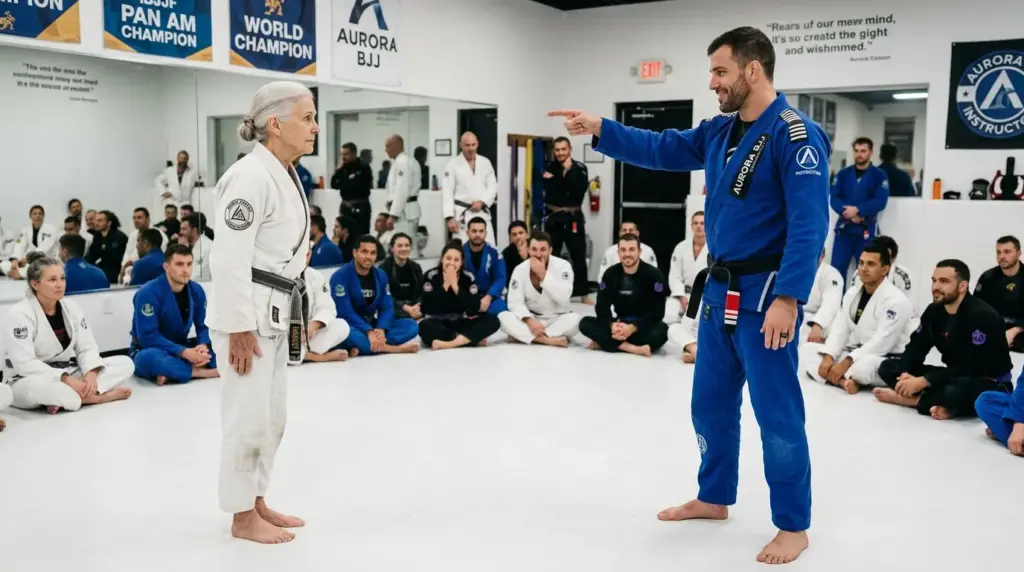
Edith adjusted her belt. “I told you. Edith Simmons. Second-degree black belt under Master Takahashi.”
One of the older students stepped forward, recognition dawning on his face.
“Wait,” he said. “Takahashi as in Hiroshi Takahashi? The one who trained those champions in the nineties?”
Edith nodded modestly.
The student stared at her. “And you’re that Edith Simmons? I read about you in old martial arts journals. You won the Eastern Regional Championships three times, didn’t you?”
A murmur spread through the class.
Jackson’s embarrassment shifted into dawning realization. He had not dismissed a confused elderly beginner. He had insulted a seasoned martial artist whose knowledge ran deeper than his own.
“That was a long time ago,” Edith said. “I never sought the spotlight. The practice itself was always what mattered.”
Jackson swallowed hard. To his credit, pride did not completely defeat him. He looked at Edith, then lowered his head in a formal bow.
“Mrs. Simmons,” he said, “I owe you an apology. My behavior was disrespectful and unbecoming of an instructor.”
Edith accepted with a slight nod.
“We all make judgments based on appearances,” she said. “It’s a human weakness. What matters is whether we are willing to correct those judgments when the truth is placed in front of us.”
A young woman with a purple belt stepped forward carefully.
“Ma’am,” she said, “that armbar transition was incredible. Would you be willing to show it again?”
Edith glanced at Jackson, raising an eyebrow.
After a moment, Jackson nodded. “I think we could all learn something today,” he said. This time, there was genuine respect in his voice. “If Mrs. Simmons is willing.”
For the next hour, what had started as a mockery became a master class.
Edith demonstrated techniques with the precision of someone who had spent decades refining the smallest details. She was not as fast as she had been at thirty-five. She did not pretend to be. But her timing was remarkable. Her leverage was exact. Her movements were economical, patient, and difficult to stop.
She showed the sleeve drag again, this time slowly. She explained how the grip should not pull with the arms alone, but connect to the hips. She showed where Jackson’s balance had broken, and why his first instinct—to push—had given her the armbar.
Students leaned closer.
The same people who had laughed were now taking notes.
She explained small adjustments most of them had never considered: the angle of the knee, the timing of the hip shift, the pressure through the shoulder, the patience required before moving from control to submission.
“In my forty-four years of practice,” Edith said as Jackson helped demonstrate a guard pass, “I have learned that jiu-jitsu is not about power or speed. Those fade with time. It is about principles that do not fade. Leverage. Timing. Balance. Patience. And most important, respect—for your opponent, your partner, and yourself.”
The students listened with full attention.
Something rare had entered the room, and they knew it.
By the end of class, the energy in the academy had changed completely. Students approached Edith one by one, asking questions that were no longer sarcastic. She answered each of them patiently, without bitterness, without trying to humiliate anyone in return. She shared knowledge because that was what knowledge was for.
Jackson watched from the edge of the mat, thoughtful and quieter than he had been at the start.
When the last student walked away, he approached Edith again.
“Mrs. Simmons,” he said, “I’d like to offer you a position here at Elite.”
Edith raised an eyebrow. “A position?”
“We have women’s classes and youth programs that would benefit tremendously from your experience. Honestly, the whole academy would benefit from your knowledge.”
“I didn’t come here looking for employment,” Edith said. “I only wanted a place to continue my own practice.”
“Of course,” Jackson replied quickly. “You would have full access to the facilities whenever you like. But if you’d consider teaching even one class a week, it would be invaluable.”
Edith considered him for a moment.
She had not expected the day to end this way. She had come in hoping only to find a mat, to keep moving, to build some small routine in a new town where grief still followed her from room to room. She had not come looking for students. She had not come looking to prove herself.
But perhaps this new chapter had come looking for her.
“I’ll think about it,” she said. “But I have one condition.”
“Name it.”
“This dojo must become a place of respect for everyone who walks through that door. Age, gender, size, appearance, experience. None of it should decide how they are treated before they step on the mat.”
Her eyes held his steadily.
“What happened today should never happen again.”
Jackson nodded. This time, there was no performance in it.
“That is a principle I should have been upholding all along,” he said. “Consider it a promise.”
As Edith gathered her things, several students bowed to her formally. It was the kind of respect usually reserved for the head instructor. The purple belt woman smiled hopefully.
“See you Thursday, Sensei Simmons?”
Edith smiled back.
“Thursday would be fine.”
As she walked toward the exit, she noticed a small group of older adults peering through the glass near the reception area. They had apparently watched part of the class and were speaking excitedly among themselves.
The receptionist approached, her expression sheepish.
“Ma’am,” she said, “there are several people asking if we offer classes for… mature students. They want to know if you’ll be teaching.”
Edith’s smile deepened.
“Tell them to come back Thursday,” she said. “We’ll see what we can do.”
Three months later, Elite Martial Arts Academy was no longer the same place.





