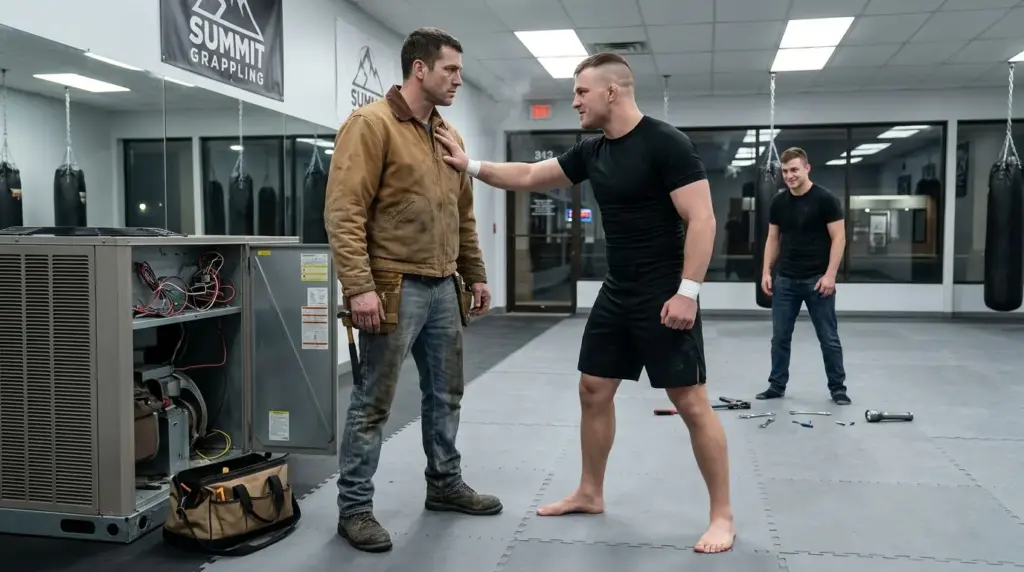
“You got a problem, wrench monkey?” Trent asked.
His voice dropped an octave.
Trying to become menacing.
Cole looked at Trent’s chest.
He refused eye contact.
Eye contact is a contract.
“No problem,” Cole said quietly. “Just need to hit the thermostat. Then I’m gone.”
“You’re tracking dirt on the mats,” Logan said from the side, moving toward Cole’s right flank.
Cole looked down.
His work boots were scuffed and stained with oil, but dry.
He had not left a mark on the gray foam.
It was a manufactured grievance.
They were building a narrative to justify what they wanted to do next.
“I wiped them at the door,” Cole said.
His voice remained flat, monotone, the way a negotiator speaks to someone standing on a ledge.
“I don’t care what you did at the door,” Trent said, taking a half step forward.
The distance closed to twelve inches.
Intimate range.
Striking range.
“These are competition mats. You take your boots off, or you get off them.”
Cole looked at the thermostat.
Twenty feet away.
Tool bag.
Thirty feet behind him.
Glass door.
Sixty feet left.
He was calculating.
It was involuntary.
Trent was heavy. Likely a grappler. Wide stance. Rooted. He would shoot for the legs or go for a collar tie.
Logan was light on his feet. Bladed stance. Striker. Probably kickboxing or Muay Thai.
Together they had weight, youth, and adrenaline.
Cole had none of that.
Just bone-deep exhaustion and a sudden, terrifyingly familiar coldness blooming in the center of his chest.
“I’m not taking my boots off,” Cole said gently. “I’ll walk on the hardwood. I just need to turn the heat on.”
He stepped left, attempting to circle around Trent.
Trent mirrored him.
This time, he raised a heavy hand and planted it squarely in the center of Cole’s chest.
“I said,” Trent growled, pushing hard, “get off the mats.”
The shove was meant to send Cole stumbling.
It was meant to make him look foolish.
Cole did not move.
The force transferred through the jacket, met the solid structure of his torso, and stopped dead.
He had not braced.
He had simply absorbed it, dropping his center of gravity a fraction of an inch, feet rooting into the floor like old oak.
Trent’s eyes widened slightly.
The confusion was brief.
Cole saw it.
The realization that the object he had pushed was much heavier and denser than it appeared.
“Take your hand off me,” Cole said.
The gravel in his voice was gone.
The tone was different now.
Not angry.
Not loud.
Absolute.
The sound of a steel door locking shut.
Logan saw his brother hesitate and misread it.
He thought Trent was still playing with his food.
“Hey, deaf man,” Logan barked, closing distance on Cole’s right side. “He told you to back up.”
Cole did not look at Logan.
His eyes were finally fixed on Trent.
He looked past the arrogance, past the cauliflower ear, straight through the pupil to the optic nerve.
“I am working,” Cole said. “I’m leaving in two minutes. Move.”
Trent sneered, recovering his bravado.
His ego could not let the failed shove go unanswered.
Especially not in front of his brother.
“Or what?” Trent said. “You going to hit me with a wrench, old man?”
Then he made his mistake.
He reached for Cole’s jacket.
Both hands.
Lapels.
A classic hockey-fight entry, meant to control posture and drag Cole into a dominant grappling exchange.
He never made contact.
The switch flipped.
It was not a conscious decision.
Not exactly.
It was a biological override.
For years, Cole had kept the vault locked. He had buried the muscle memory beneath layers of civilian routine: oil changes, wiring jobs, thermostat repairs, dog food, cheap coffee, quiet evenings.
But violence is a language.
Trent had just spoken it fluently.
Cole’s nervous system answered.
Before Trent’s thick fingers could grip the canvas jacket, Cole moved.
Not with the wild swing of a bar fighter.
With terrifying economy.
His left hand shot upward, not as a fist, but as a rigid wedge. He parried Trent’s reaching arms from the inside, deflecting them outward with a sharp crack of forearm against forearm.
Trent grunted.
His guard opened.
His chest exposed.
Cole did not punch.
Punching breaks hands.
Punching is for rings and gloves.
Instead, Cole stepped into the space Trent had just vacated, sliding his lead foot behind Trent’s ankle. At the same moment, he drove the heel of his right hand upward into the center of Trent’s chest, over the sternum.
A structural strike.
A breath-stealing strike.
A strike designed to disrupt the respiratory system long enough to end the question.
Coupled with the leg sweep, it was devastating.
Trent’s feet left the ground.
For a fraction of a second, he hung in the air, his face a mask of sudden paralyzing shock.
Then he slammed backward onto the mats with a sickening thud.
The breath left his lungs in a violent whoosh.
He lay staring at the ceiling, gasping like a fish thrown onto a dock, his diaphragm locked in spasm.
It had taken less than a second.
Logan froze.
He was mid-stride, hands half-raised in a loose fighting stance.
His brain could not process the telemetry.
One moment, his two-hundred-twenty-pound brother was dominating a tired mechanic.
The next, Trent was on his back, incapacitated by a blur of movement Logan had not even tracked.
Cole did not admire his work.
The threat was not neutralized.
There were two hostiles in the room.
He pivoted sharply and turned his full attention to Logan.
The slouch was gone.
The exhausted mechanic had vanished.
The man standing on the mats now was a kinetic weapon.
Balanced posture.
Hands open near the chin.
Chin tucked.
Elbows tight.
Eyes wide, cold, and dead, processing distance, angles, weight distribution, and physiological vulnerabilities.
Logan felt an icy spike of terror pierce through his adrenaline.
This was not the hesitant guy from a moment ago.





