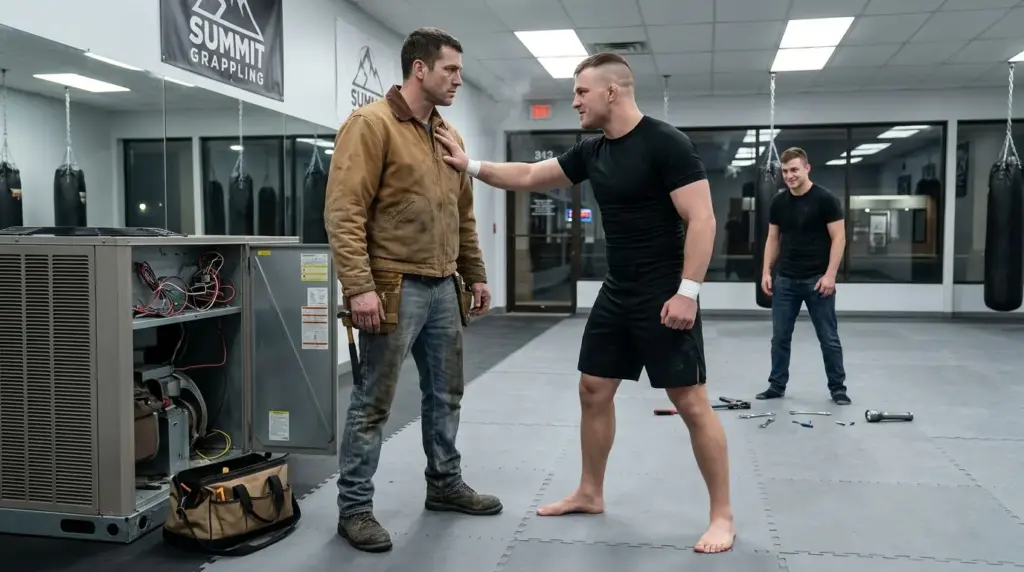
Completely empty of gym camaraderie.
Logan looked up, defensiveness kicking in.
“Didn’t what? The guy was being a jerk. He was tracking dirt everywhere and dropping tools.”
“Shut up, Logan,” Davis said.
Not a yell.
An absolute command.
Davis walked onto the mats. His sneakers squeaked softly.
He stopped in front of Trent and looked down at him.
“Where did he hit you?”
Trent looked away, humiliated.
“He didn’t hit me. He— I don’t know what he did. Sucker punched me.”
“He didn’t sucker punch you,” Davis said. “If he punched you, your ribs would be in pieces.”
He pointed at Trent’s chest.
“He palm-heeled your sternum and probably swept your lead leg while he did it. Am I right?”
Trent’s silence answered.
Davis rubbed the bridge of his nose.
Then he looked at Logan.
“And you?”
Logan swallowed.
“I threw a combination. He slipped it. Had an elbow on my eye before I could blink.”
Davis let out a dry, humorless chuckle.
“You’re lucky you still have an eye. You’re lucky you still have a jaw.”
Trent pushed himself onto his knees, face twisted with pain and bruised ego.
“Who is that guy?”
Davis looked toward the humming vents.
“His name is Cole.”
“He’s just an HVAC repairman.”
“Yeah,” Davis said. “He fixes air conditioners because he wants to be left alone.”
He turned back to the brothers.
“Because he spent eight years doing things in the dark that you two could not handle watching on television.”
The room went still.
Davis’s disappointment was heavier than anger.
“You guys come in here, learn some jiu-jitsu, win a couple of local tournaments, and think you’re killers.”
His voice dropped.
“You think you know what violence is. You don’t. You know a sport. You know a game with rules, a referee, and a soft mat to land on.”
He pointed toward the door.
“That guy out there does not know the sport. He knows how to dismantle human architecture.”
Logan stared at him.
Davis continued.
“He spent his twenties in a special mission unit. He survived by being faster and more ruthless than people who would cut your head off for a pair of boots. I hire him because he does good work, he does not overcharge, and he deserves a quiet life.”
Trent lowered his eyes.
Davis picked up his coffee.
“Pack your gear. You’re done for the night.”
Neither brother moved.
“And tomorrow,” Davis added, “if you see him in town, you cross the street.”
Logan looked like he wanted to argue.
Davis cut him off before he could.
“The only reason both of you are walking out of here tonight is because that man has more self-control in his little finger than you two have in your entire bodies.”
He looked at Trent.
Then Logan.
“He gave you your lives back. Don’t make him regret it.”
In the Ranger, the heater finally kicked in, blasting dry dusty air into Cole’s face.
The trembling in his hands had settled into a dull stiffness in his knuckles.
He put the truck in gear and pulled out of the parking lot, merging onto the empty four-lane road.
He drove the speed limit.
Exactly forty-five.
The city rolled by in closed gas stations, dim intersections, and sleeping suburban houses. Reflections of streetlights slid across the scratched windshield.
Cole did not feel victorious.
There was no masculine pride.
No satisfaction.
Just a crushing exhaustion.
He thought about Logan’s face, about the naked terror in the kid’s eyes when the elbow stopped.
Cole knew that look.
He had seen it in alleys in Fallujah.
In mud-brick compounds.
In rooms where men realized the universe was indifferent and that their next breath depended entirely on the mercy of whoever held the weapon.
Cole hated putting that look on a kid’s face.
Even an arrogant kid.
He turned on the radio and kept the volume low.
Static-laced classic rock filled the cab.
Grounding him.
He was not overseas.
He was not wearing armor.
He was not carrying a rifle.
He was just a man going home.
Twenty minutes later, he pulled into the gravel driveway of a small, single-story rental house on the edge of town.
The paint was peeling.
The porch slumped slightly to the left.
But the yard was neat.
Before he killed the engine, he heard it.
Thump.
Thump.
Thump.
Thump.
A tail against the other side of the front door.
Cole smiled.
Small.
Subtle.
But it reached his eyes.
The tension in his shoulders finally broke.
He grabbed his tool bag, locked the truck, and walked up the wooden steps.
He opened the door.
A seventy-pound mutt waited for him, his entire back half wiggling with violent joy.
Rusty was a chaotic mix of German Shepherd and something blocky and stubborn, probably pit bull. He was missing half of his left ear from a fight he had gotten into before Cole found him at the shelter. His coat was the color of rusted iron.
“Hey, Rusty,” Cole said softly.
Rusty whined and pressed his heavy head against Cole’s knee.
Cole dropped the bag, knelt despite the sharp twinge in his joint, and buried his grease-stained hands in the thick fur of the dog’s neck.
He scratched behind the good ear and let the animal’s uncalculated affection wash over him.
Dogs did not care about the switch.
They did not care what you had done.
They did not care how fast your hands were.
They did not care what violence you kept locked away.
They cared that you came back through the door.
Cole stood, hung his Carhartt jacket on a peg, and walked into the kitchen.
The house was cold.
He did not mind.
He filled a metal bowl with kibble and set it down.
Rusty ate with loud crunching efficiency.
Cole went to the sink and turned on the hot water.
He squirted harsh orange pumice soap into his palms and began to scrub.
Hard.





