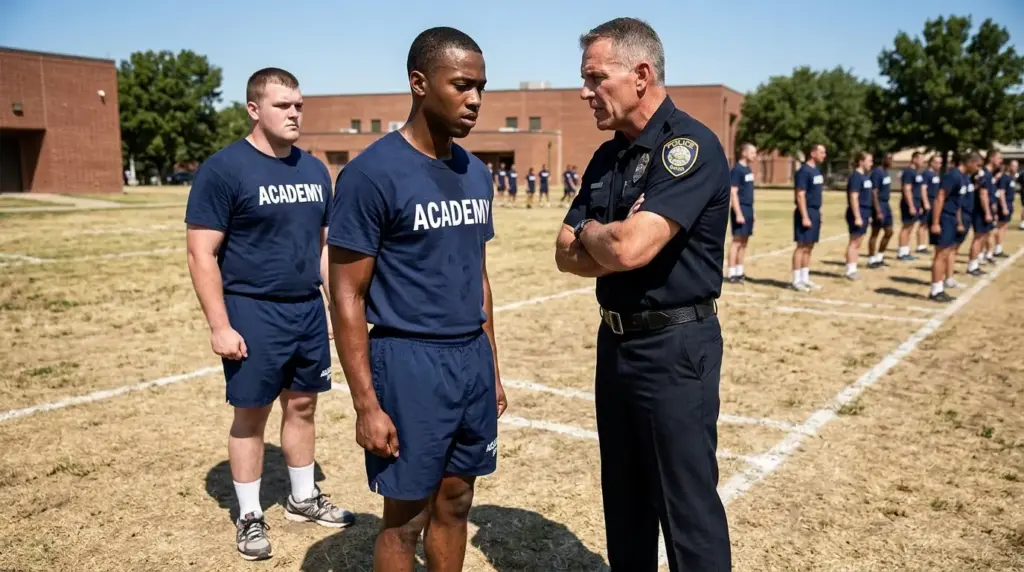
“You look like you wandered into the wrong place, kid. You don’t belong here.” Sgt. Delphine Parcher’s voice carried across the training field. The trainees heard it. A few laughed, the sound sharp, brief, dying quickly against the open space. Mack Werden didn’t move. He stood exactly where he was and took it without flinching, without lowering his eyes, without giving Parcher a single thing. What Sgt. Parcher did not know was that he had just picked the one man in the roster who was a third-degree black belt in karate and had spent years learning discipline more than anything else.
The mirror didn’t lie. Mack Werden stood in front of it at 5:00 in the morning, buttoning his white undershirt with slow, deliberate fingers. The bedroom light was harsh and bright. Every crease in his face was visible. Every line around his eyes. He looked at himself the way a man looks at something he has been building for a long time. Not with pride, exactly. With readiness.
Behind him, on the shelf above the dresser, three national championship plaques caught the light. Gold lettering. His name over and over. He didn’t look at them. He already knew what they said. He pulled on his pants, tucked in his undershirt, and stood straight. The man in the mirror looked like he meant business.
Mack had wanted to be a police officer since he was 12 years old. Not because the job was glamorous. Not because he grew up watching cop shows on television. He wanted it because of one specific Tuesday afternoon in October, 16 years ago, when his father, Jonathan Werden, a man who wore a suit to the grocery store, who carried a leather briefcase and argued cases in federal court, was pulled over on Meridian Avenue and treated like a criminal. Mack had been in the backseat. He remembered his father’s hands, flat on the steering wheel, completely still, knuckles visible. Jonathan hadn’t said a word out of line, hadn’t raised his voice, hadn’t done anything except exist in the wrong car on the wrong street at the wrong time. And the officer had spoken to him like he was nothing.
That was the day Mack understood something. Not that the system was broken. His father had been telling him that for years. What he understood, sitting in that backseat at 12 years old, was that broken things could be fixed. But only if someone was willing to get inside them.
He turned off the bedroom light. Jonathan was in the kitchen doorway when Mack came down the stairs, coffee in one hand, the other hand hanging loose at his side the way it always did when he was holding something back. Jonathan Werden was 58 years old and had spent 30 of those years fighting in courtrooms for people who had been chewed up by the very institutions that were supposed to protect them. He knew exactly what his son was walking into.
“You eat anything?” Jonathan asked.
“I’ll grab something after.”
Jonathan nodded slowly. He looked at Mack the way Mack had looked at the mirror, like he was calculating something. Then he said quietly, “You know what they’ll see when you walk in that door?”
Mack picked up his keys from the counter.
“I know what I’ll see when I walk out.”
Jonathan didn’t argue. That was the thing about Jonathan Werden. He knew when a man had already made up his mind. He just watched his son go, coffee warm between both hands now, standing in the kitchen doorway until the front door closed.
The drive took 22 minutes. Mack kept both hands on the wheel and the radio off. The city moved past the windows in early morning gray. Storefronts with their gates still down, streetlights still on, a delivery truck idling outside a convenience store. Everything quiet and unhurried. Mack drove like he did most things, deliberately, without wasted motion.
Precinct Nine’s Academy Annex sat at the end of a long block on the east side. It was a squat brick building, old and institutional, with narrow windows and a parking lot that needed repaving. A chain-link fence ran along the left side. A flagpole stood out front with the state and city flags hanging limp in the still morning air. There was nothing welcoming about it. Mack pulled in at 6:57, three minutes early. He cut the engine and sat for a moment, scanning the lot. There were already eight or nine cars. A few trainees he didn’t recognize were walking toward the entrance in small groups, talking in low voices. They wore the standard-issue training uniform, plain white T-shirts and dark navy shorts, the fabric stiff and new-looking against the morning light. It was the same kit waiting on Mack’s kitchen chair when he’d packed his bag the night before. He was the only black man he could see. He noticed it the way you notice weather. Not with surprise, exactly. Just acknowledgement. A data point that told him what he already knew about where he was and what was waiting.
Mack got out of the car. He straightened himself, picked up his folder of paperwork from the passenger seat, and walked toward the entrance with his head level and his pace steady. The door was heavy. It swung shut behind him with a sound like a verdict.
The field was already bright when the trainees assembled, the morning sun cutting hard across the open ground and throwing long shadows off the tree line at the far edge. Eleven of them stood in a loose line along the near side of the field. Most of them stiff with the particular nervousness of a first morning. All of them in matching white. Shirts already showing the heat at the collar. Dark shorts uniform down the line. A few looked over when Mack crossed the field to take his place. A couple looked away quickly. He found his spot in the line. He stood straight. He waited.





