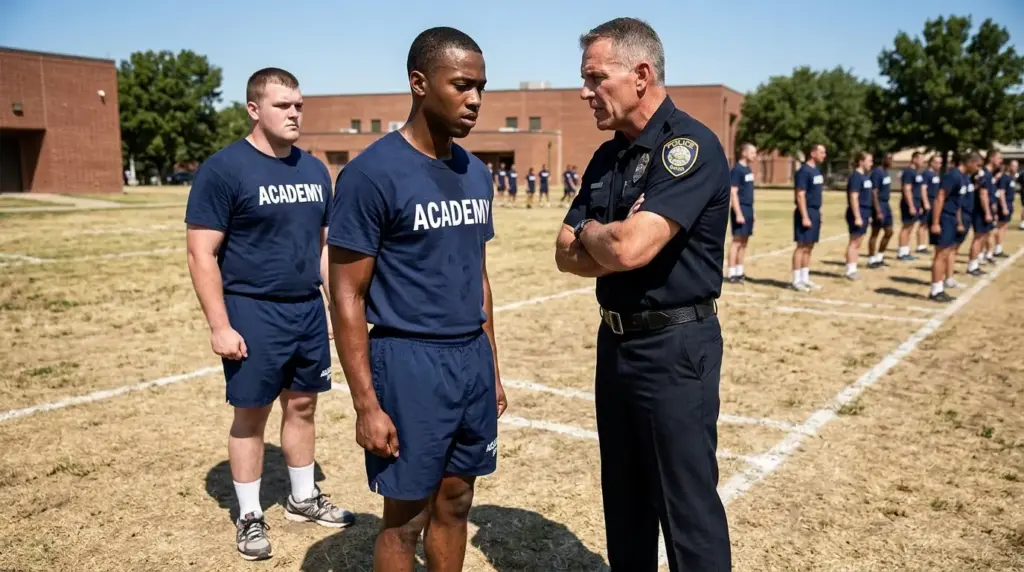
Sgt. Delphine Parcher came around the corner of the Annex building like a man who had somewhere more important to be and was doing them a favor by stopping. He was a compact man, not tall, not particularly built, but he moved like someone who had never once been told to wait. 54 years old with a face that looked like it had been left out in bad weather, creased, reddish, permanently set into something between a squint and a sneer. His uniform was pressed within an inch of its life. The full navy blues of a department sergeant. Badge polished to a hard gleam in the morning sun. Radio clipped at the shoulder. Boots mirror clean against the pale dirt of the field. He looked like a man who used the uniform as a weapon before he opened his mouth. He didn’t say good morning.
He walked the line slowly, hands clasped behind his back, scanning each trainee from head to foot the way a man inspects something he already expects to be disappointing. He stopped at the first trainee, a kid of about 22 with slightly scuffed shoes, and stared at the shoes for a full 5 seconds without speaking. The kid’s face went red. Around them, the open field offered nowhere to look and no cover to stand behind. Everything was visible out here. That was the point.
“You shine those with a dirty sock,” Parcher said. Nobody laughed. Nobody breathed. He kept moving. A grunt at the next trainee. A dismissive head shake at the one after that. He was performing and everyone in the line knew it. And no one was going to say so. The tree line stood still at the edge of the field. The sun climbed and did not care. Then he reached Mack. He stopped. The silence stretched out, more exposed somehow in the open air than it would have been between four walls.
Parcher looked Mack up and down once, slowly, like he was reading the back of a cereal box. Then he looked down at his clipboard and dragged his finger along the roster until he found the name. His finger stopped. “Werden.” He let the name sit in the morning air for a moment. Then he looked up. And there was something in his eyes that wasn’t confusion or curiosity. It was a decision.
“You look like you wandered onto the wrong field, son. Community center’s about two blocks north.” Laughter broke out immediately. Sharp, quick laughter from Brick Hamilton, a thick-necked trainee at the far end of the line, and two others close to him. Out here, it had nowhere to go. It just hung in the open air and faded. Not everyone laughed. Most of the line stayed still, eyes forward. The particular blankness of people who want no part of what they’re watching, but won’t say so, either. Mack didn’t move. He kept his posture exactly where it was, back straight, chin level, eyes on the middle distance, fixed on tree line at the far edge of the field, steady and unchanged, the way he intended to be.
He let the laughter run its course, and when it died out into the morning quiet, he said, without any heat in his voice at all, “I appreciate the concern, Sergeant, but I checked the address twice.”
The laughter stopped. Parcher’s expression didn’t change, not exactly, but something behind his eyes shifted. He’d expected embarrassment. He’d expected the flinch, the dropped shoulders, the red face, the mumbled apology. That was the reaction men like Parcher built their whole game around. Out here on the open ground with the sun overhead and nowhere to hide, that flinch was supposed to be inevitable. Mack had given him nothing, just a calm, clear sentence and steady eye contact. Parcher stared at him for one more second. Then he moved on down the line, but his eyes came back to Mack twice before he finished the roster. Mack noticed both times.
The morning session was classroom work. Protocols, department regulations, a 40-minute lecture on use-of-force policy that Parcher delivered like a man who found his own material exhausting. Mack took notes. He stayed focused.
The afternoon was different. They moved outside. The training field behind the annex building was wide and flat, bordered on three sides by a dense tree line that stood dark green and still against a sky that had opened up into full aggressive blue. The sun was high and direct, no clouds, no relief. And it hit the pale dirt and scrubbed grass of the field with the particular force of a day that intended to be brutal. The air smelled of dry earth and cut pine from the tree line. It was the kind of afternoon that made everything feel overexposed.
The trainees assembled in a loose formation along the near edge of the field. Their white T-shirts caught the sun immediately, already showing sweat at the collar and between the shoulder blades on the trainees who had been moving around setting up equipment. Parcher stood at the center of the field in his full navy uniform, badge glinting in the direct light, not a button undone, looking entirely unmoved by the heat. His radio crackled once and went quiet. He silenced it without looking down. He called out equipment assignments from his clipboard, turning slowly as he spoke so his voice carried to the far ends of the formation. Trainees received their gear.
When he reached Mack, he assigned him the heaviest sandbag pack in the pile, nearly 15 lb more than the standard issue. He did it without looking up from the clipboard, without explanation. “Equalizing standards,” Parcher said flatly, “moving on.” The run was 3 miles down the perimeter path that skirted the tree line and doubled back through the open field. The sun tracked them the whole way. No cover on the open stretch, only thin shade where the path cut close to the pines. The white shirts of the group ahead of Mack flashed in and out of the tree shadows like a scattered flock. Mack ran at a steady pace with the extra weight and finished in the top third of the group, shirt dark with sweat down the spine and across both shoulders, breathing hard but controlled.