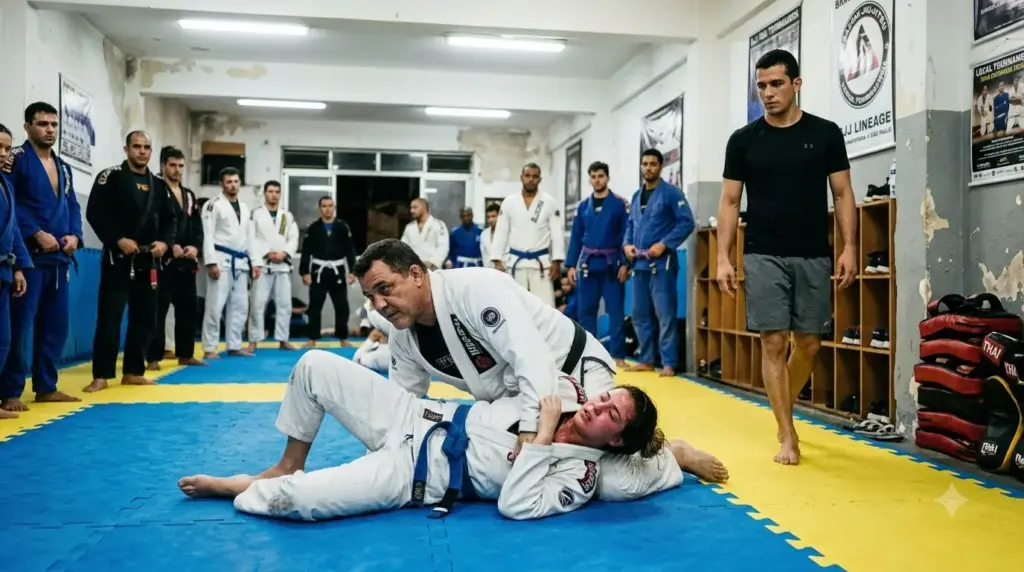
Dale shot for a takedown at the fifteen-second mark with the aggressive practice efficiency of a competition-trained athlete.
Quinn sprawled, redirected the momentum, and came out behind Dale’s hips in under two seconds.
The room went quiet in a different way than before.
Dale reset.
His expression had changed.
The recalibration was visible.
He shot again, varied the angle, drove harder.
Quinn moved off the line in a way that was almost economical to the point of being invisible, using Dale’s speed against the direction he’d committed to.
And Dale went to the mat with his own force.
He got up fast.
He was not, whatever else he was, a man without competitive heart.
“You’ve trained somewhere serious,” Dale said.
“Yes,” Quinn said.
“Where?”
“Somewhere you haven’t been.”
He shot a third time, fainted low, went high with a collar tie.
That was technically excellent.
And Quinn slipped it, stepped through, and put Dale on his back with a controlled trip that wasn’t dramatic, wasn’t punishing, was just precise.
He followed him to the mat, established top position, and applied pressure in a way that made it very clear that the next movement in this sequence was entirely his to choose.
Dale tapped.
Quinn stood up.
He wasn’t breathing hard.
He offered Dale a hand.
Dale didn’t take it.
He stood up on his own and picked up his bag and walked out of the gym without speaking to anyone and the door swung shut behind him and for a moment the room was completely silent.
Then someone toward the back started clapping.
A few others followed, not enthusiastically, not in the way of performance, just in the honest way of people who had witnessed something they’d needed to see.
Savannah bent down and picked up her water bottle.
Her hands were steady.
Her chest was not.
Garrett came around from behind the desk, which was the first time she’d seen him fully cross the room since the situation with Dale had started.
He stopped near Quinn and stood there with his arms at his sides.
“I should have done something sooner,” Garrett said.
Quinn looked at him.
“Yes,” he said.
“You should have.”
“It wasn’t cruel the way he said it. It was just true.”
And Garrett received it the way people receive true things that cost them something, with his face doing several things at once, and none of them comfortable.
Savannah thought the morning was over then.
She thought the tension had broken and the room would slowly go back to training and by afternoon things would feel different if not resolved.
She was wrong because at twelve forty-seven p.m. while she was in the changing area pulling her coat on her phone rang.
The screen said Denton General admin.
She answered immediately.
“Ms. Cole,” a voice she didn’t know.
“This is the director’s office at Denton General. I’m calling to inform you that we’ve received a formal legal communication today regarding your employment status. A civil suit has been filed naming you as a defendant by officer Dale Ror alleging defamation and tortious interference with his professional duties.”
A pause.
“Hospital legal has been notified. HR is asking you to come in Monday morning before your shift.”
She stood in the changing area with her coat halfway on and the ambient noise of the gym filtering through the door.
A civil suit, not a complaint, not a union call.
A lawsuit filed in civil court naming her by name targeting her employment running parallel to the departmental review designed to bury her in legal costs and professional uncertainty before the hearing could be decided.
“Miss Cole, are you there?”
“Yes,” she said.
“I’ll be there Monday.”
She hung up.
She finished putting her coat on.
She pushed through the door to the main floor where Quinn was still there talking quietly to Steph and when he looked at her face he excused himself from the conversation and came across the room.
He read her expression before she said a word.
“What happened?” he said.
She told him.
She kept her voice level and her account specific and she did not despite the sharp and specific fear that was moving through her right now allow it to make her voice unsteady.
When she finished Quinn was quiet for a moment.
“He filed it today,” he said.
“Same day he received the formal hearing notice.”
“Yes, he has a lawyer who had this ready in advance.”
Quinn’s voice was controlled, but something in it had shifted.
Not anger, but the tonal quality of someone whose assessment of a situation has just changed significantly.
“This isn’t improvisation. He’s been preparing a legal response since he got the complaint notice.”
“I know,” she said.
“Savannah, he stopped.”
“This is going to get to the press. The Tribune reporter already has your name. A civil filing is public record.”
She looked at him.
“I know that, too.”
“Are you okay?”
It was the second time in two weeks someone had asked her that question in a way that meant something, and she took a moment to answer it honestly.
“No,” she said.
“Not right now.”
A breath.
“But I’m not done.”
Quinn held her gaze for a moment with an expression she’d seen exactly once before.
On the face of a surgeon who’d just finished a procedure he wasn’t sure would work and was watching the monitors for the answer.
“Sandival needs to know tonight,” he said, “I know. And Savannah, there’s something I didn’t tell you. Something I’ve been holding until the right time.”
He stopped.
“The wrong time is now, which means the right time was earlier, and I’m sorry for that.”
She looked at him.
“What is it?”
He glanced around the gym, assessing the room with the automatic habit of someone for whom that was always the first step.
Then he looked back at her.
“The use of force reviews that were closed early,” he said.





