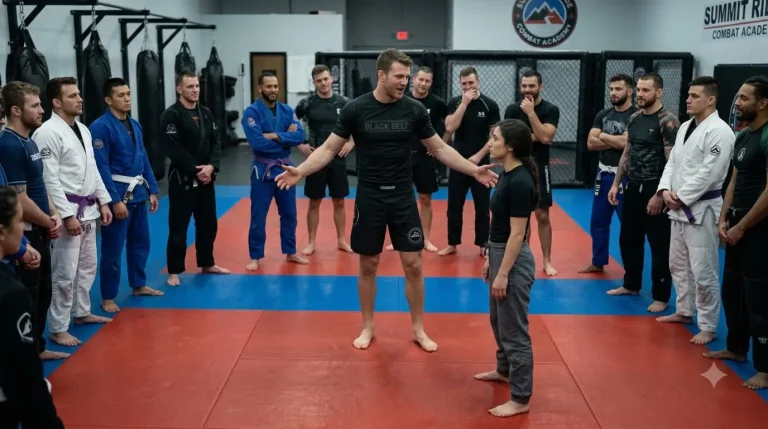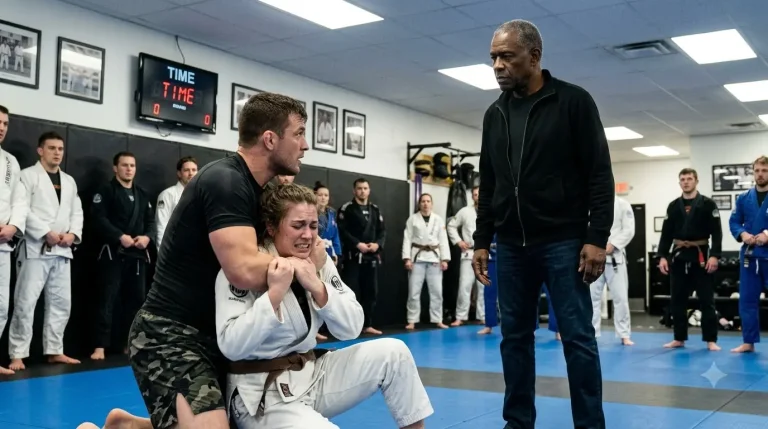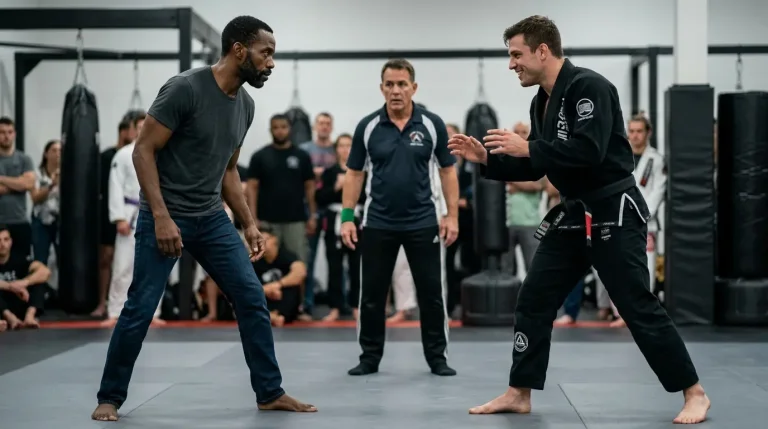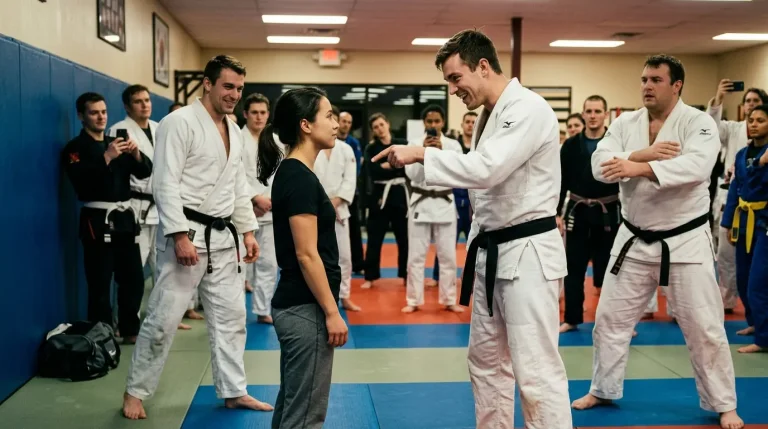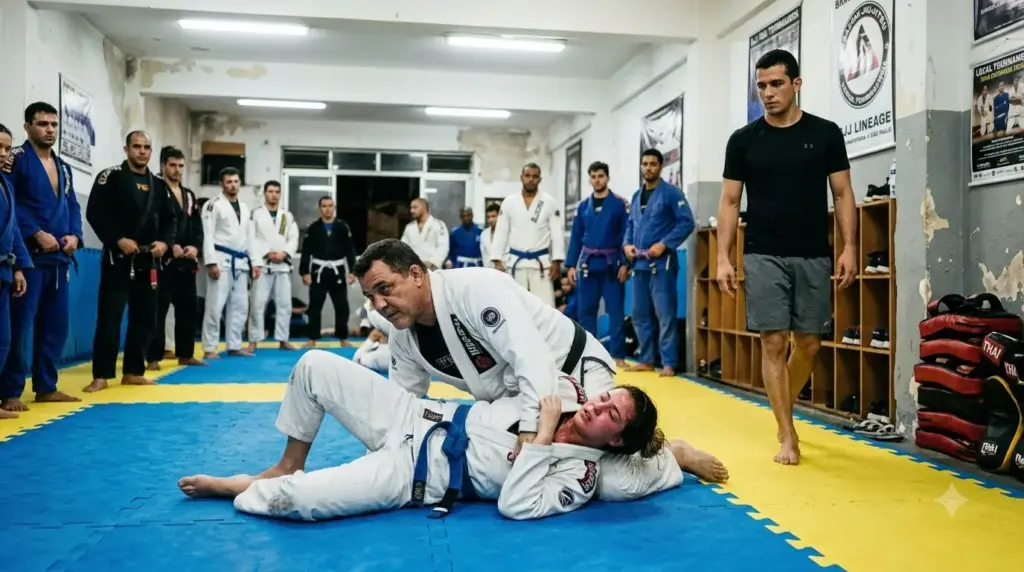
She postured, twisted hard, burned herself out of the grip with enough force that she was breathing heavy when she got free.
“There you go,” Dale said.
“See, you can move when you have to.”
She said nothing.
She left before the class formally ended.
In the parking lot, the cold October air hit her face, and she stood next to her car for a while, not yet ready to sit down.
The thing about working in emergency medicine was that you learned to catalog damage quickly.
What was serious? What would heal? What was going to need attention if it kept happening?
She ran that assessment now, except not on a patient, on herself.
She had a problem.
The problem had a name and a black belt and a gym full of people who’d decided that conflict with him wasn’t worth the cost.
She got in her car and drove home the long way through the part of Denton that ran along the river, where the traffic thinned out and the lights were further apart.
She thought about the nine years she hadn’t talked about, the part of her life that existed before night shifts in Phoenix and the careful architecture of a quiet, manageable existence.
She thought about all the things she’d learned during those years and all the reasons she decided to step back from them, and she thought about what it would mean to stop pretending she’d never learned any of it.
She didn’t make any decisions that night, but she stopped pretending the problem was going to solve itself.
The following Saturday, she arrived at the gym for open mat, something she’d never done before.
Open mat was informal.
You showed up, you found a partner, you rolled.
No instruction, no structure, just whoever was in the room and willing to go.
She didn’t know what she was looking for exactly.
Maybe just to take up space and see what happened.
Maybe to remind herself she had some standing to be here.
What she found instead was the man from the bench.
He was there early, alone on the far mat, going through movement drills by himself, with the focused, unhurried quality of someone who didn’t need an audience.
She watched him for a few minutes while she stretched.
The thing she’d noticed before was clearer now with more time to look at it.
There was no wasted motion, not in a practical looking way, not in the way competitive athletes sometimes move to signal competence, just genuine economy, nothing spent that didn’t need to be.
She walked over.
“I never got your name,” she said.
He paused, looked at her.
“Quinn,” Savannah, he nodded.
“You came back, apparently.”
He gestured to the mat.
An invitation, not a demand.
She sat down across from him, and they started to spar lightly, far below competition pace, more like a conversation between two people learning each other’s habits.
He was immediately strikingly different from anyone else she’d trained with at Irongate.
He gave her space without giving her easy openings.
When she made a mistake, he didn’t punish it.
He let her work her way out of it, or he’d back off and give her a chance to reset.
And she understood after a few minutes that he was reading her the way she sometimes read patients, not the obvious symptoms, but the underlying ones.
“You’ve trained before,” he said during a break.
“Not a question.”
She looked at her water bottle.
“A long time ago.”
What kind?
She considered how to answer that.
Combatives, military adjacent program.
I was a contractor for a while after my nursing degree, embedded with a unit overseas for a couple of years.
Ran medical support.
She paused.
“I quit. It was a long time ago.”
Quinn was quiet for a moment.
“Why’d you stop training after?”
She shrugged, which was the version of an answer she was comfortable giving.
He didn’t press it.
They drilled for another forty minutes and by the time she left she felt something she hadn’t felt in the gym before.
Not threatened, not performed at, not managed, just present.
She came back the following Saturday and the Saturday after that.
She and Quinn developed a quiet, unspoken training arrangement.
They rolled together when she was there, sometimes talked briefly afterward.
Occasionally, she asked a technical question and he gave a specific, useful answer without embellishing it.
She started sleeping better.
Not great, but better.
She started showing up to fundamentals on time instead of sitting in her car for ten minutes first.
And then Dale came back into it because Dale Ror did not like things in his orbit that he didn’t control.
He approached her on a Thursday at the end of November during the open mat portion after class.
He’d been watching her.
She’d noticed, not constantly, but periodically with the particular attention of someone recalibrating.
She’d been moving better, drilling sharper.
The weeks of working with Quinn had rebuilt something in her body memory that she’d spent years letting go dormant, and it was starting to show.
Nothing dramatic, nothing that would advertise itself to a casual observer.
But Dale wasn’t a casual observer.
“You’ve been holding out on us,” he said, crouching near the mat edge where she was finishing a water break.
She looked at him flatly.
“You’ve got actual training somewhere in there,” he said.
“Where’s it from?”
“Old job,” she said.
He smiled.
The same smile from before.
The one that contained a proprietary quality, like he was deciding what category to put her in.
“We should drill together properly. I’ve been going easy on you.”
She looked at him for a long moment.
“You weren’t going easy.”
His smile shifted.
“I’m extending an invitation, Savannah.”
“Most people in this gym would…”
“I heard you,” she said.
“I’ll think about it.”
She got up and walked to the other side of the mat.