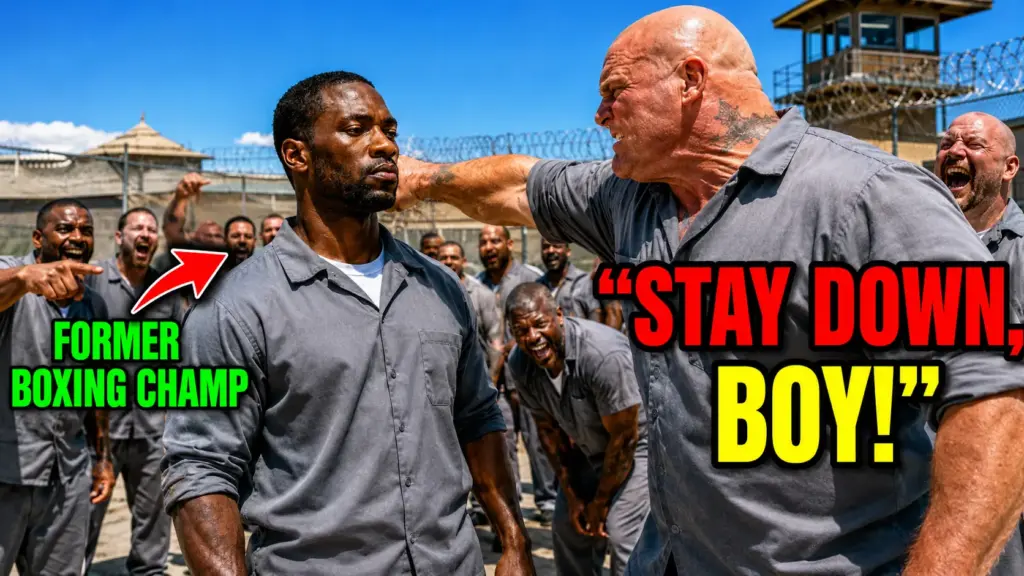
“Including the corridor outside the C-Block showers.”
The room changed temperature.
Pruitt, standing against the wall, went still in a way that everyone noticed. Because Pruitt had known the old camera schedule by heart. He had not known about the new one. Nobody on the floor had. It was a memo he’d never read. A second eye he’d never accounted for. Recording quietly while he turned his back at the far desk.
Brooks opened her laptop. She did not play the fight. She played the seven nights.
Night one. A grainy corridor feed, time-stamped. Three men outside Blake’s cell. The mattress dragged out. A boot coming down on something small and square.
Night three. Hartley’s crew laughing at the mail slot.
Night five. Blake against the cinder-block wall with the phone to his ear and Hartley leaning in to pat his cheek. Twice. Soft.
And the seventh night. The corridor outside the showers. Four men filing in. Hartley last, throwing the bolt behind him. The timestamp read 9:14 p.m.
“My client,” Brooks said quietly, “entered that room at 9:13. Four men followed and locked the door from inside. You will notice no one is dragging anyone. You will notice who turned the lock.”
She closed the laptop.
“That is not an ambush by one man. That is an ambush of one man.”
The corrections official was writing fast now. Cole had stopped pretending to be calm.
But Brooks wasn’t finished. Because the panel still had the easy thought waiting in the back of their minds. The one the headlines had planted. Convicted felon. Trained fighter. Even cornered, didn’t he do too much? Four men in the infirmary. One with a shattered jaw. Wasn’t that the act of someone dangerous?
So Eleanor Brooks reached into her folder and pulled out the thing she had been saving.
“You keep calling my client trained,” she said. “Let me tell you how trained.”
She slid a sheet across the table.
“Blake Foster. Eighteen professional fights. Eighteen wins. Fourteen knockouts. State lightweight champion. Ranked before his arrest in the national top fifteen.”
She let the panel read it.
“This is not a man who learned to brawl in a yard. This is a professional athlete whose hands are quite literally registered weapons.”
Cole frowned.
“You’re proving our point. He’s dangerous.”
“I’m proving the opposite,” Brooks said. “And in about ten seconds, you’ll see why.”
She played the fight then. Once at full speed. Then again, slowed down, frame by frame. The way the whole internet had already watched it a hundred million times.
“A fighter at his level,” she said, narrating over the slow motion, “throws a punch that generates enough force to end a life. He knows it. It’s the first thing they teach you. So watch what he does with four men trying to hurt him in a locked room with every legal and moral right to defend himself by any means.”
She pointed.
“First man. A body shot. Not the head. The body. Drops him. Doesn’t damage him.”
“Second man. He uses the man’s own momentum. Redirects him into the wall. One short counter.”
“Third man. Mr. Hartley.” She froze the frame on the check hook. “One punch. Clean. He could have followed up. A man on the floor is a man you can finish. He doesn’t. He steps back.”
She advanced the footage to the final seconds. Blake, untouched, kneeling beside the second man, checking his breathing.
“There it is,” Brooks said softly. “The most dangerous man in the room, on his knees, making sure the person who came to hurt him is still breathing.”
She looked at each panel member in turn.
“A man who wanted to hurt them could have crippled four people in twelve seconds. He had the skill. He had the right. Instead he used the exact minimum force to survive. And then he rendered aid. That is not the record of an animal. That is the most disciplined self-defense any of you will ever see on a screen.”
The room was silent. The kind of silence Blake knew well. The kind that falls right before a decision.
The corrections official turned to Pruitt.
“Officer. The pilot cameras. Were you aware of them?”
Pruitt opened his mouth. Closed it. The pause was its own answer, and everyone heard it.
“Where were you,” the official continued, “the night of the incident? During the disturbance?”
“At my desk,” Pruitt said. “Doing reports.”
“With your back to the tier,” Brooks added. “We have that on camera too.”
It came apart quickly after that. The way these things do once the first thread pulls. The fractured-jaw victim statement collapsed against the footage of a man throwing a bolt. The witness accounts—all from Hartley’s crew—turned to smoke. And one inmate who had stayed silent out of fear, an older man named Walter Hayes, stepped forward now that there was finally something to step toward, and told the panel about seven nights of cruelty he’d watched and could not stop.
Blake sat through all of it without moving. He had learned in the box not to hope. But when the corrections official set down her pen and said the words pending immediate review of Officer Pruitt’s conduct and the conditions in C Block, something in his chest loosened for the first time in weeks.
He thought of his mother. He thought, for the first time, that he might actually make it home in time.





