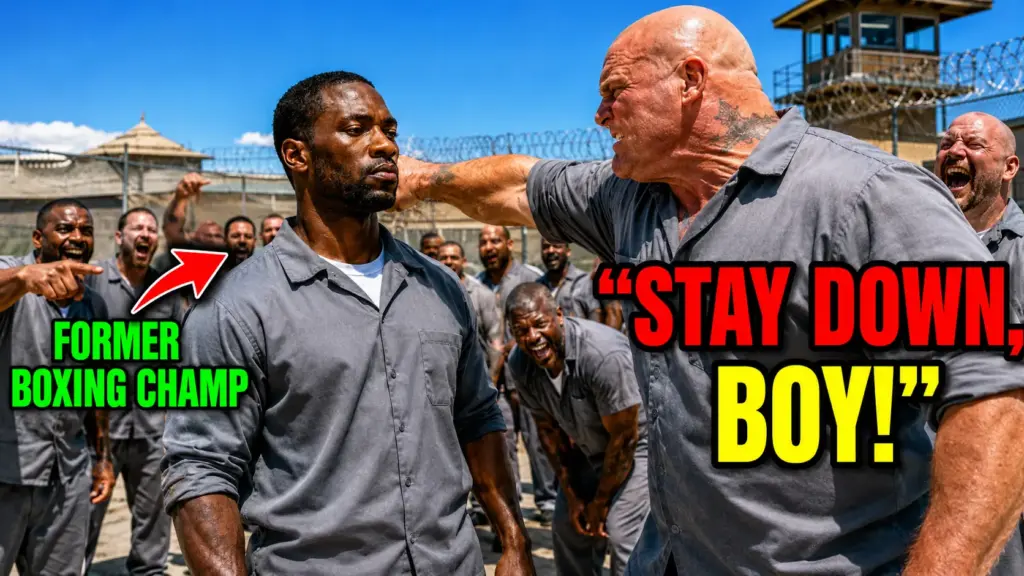
“They built their whole case,” she told him, “on a camera they thought was off.” She almost smiled. “They forgot the one watching them.”
Justice, when it finally moved, moved fast.
The footage from the pilot cameras went to the state corrections board, then to the district attorney, then inevitably to the press that had been camped outside Ironwood for two weeks. The official story did not survive contact with the truth. Seven nights of corridor footage do not lie. A locked shower door does not lie. And a man kneeling to check his attacker’s breathing does not lie.
Wade Hartley was charged with felony assault—four counts—for the ambush he had filmed himself. His own trophy became the case against him. The wired jaw he had used for sympathy turned out to be the least of his problems. He was already serving time for the coma he’d put a man in years before. Now the parole he’d been counting on vanished, and the court added eight years to a sentence he’d thought was nearly done.
The king of C Block walked out of the hearing in cuffs to a silence from the other inmates that was louder than any cheer.
Officer Dale Pruitt did not go quietly. But he went. The investigation into the missing tier footage found exactly what Eleanor Brooks had promised it would. A pattern of arranged blind spots. Ignored complaints. And reports written to protect the man who kept his block quiet. Pruitt was stripped of his badge and charged with falsifying records and willful neglect. The nod he had given Hartley across a chow hall—the smallest thing imaginable—had become the thing that ended his career.
Warden Garrett Cole resigned before they could remove him. The man who hated attention left under the brightest lights of his life, trailed by cameras down the same steps he’d hoped to keep clear.
A state monitor was assigned to Ironwood. The pilot-camera program—the one accident that had saved an innocent man—was made permanent and expanded to every block.
And then there was the conviction that had put Blake inside in the first place.
Eleanor Brooks did not stop at the prison case. She took the robbery conviction apart the way she took everything apart. Slowly. In daylight. The grainy tape. The rushed lineup. The forty-case public defender who’d barely read the file. She found the gas station’s original footage—the full version—and a clerk who, shown a clear photo at last, said the words that should have been said three years earlier.
“That’s not him. That man was heavier. Older. That’s not the man.”
The court vacated Blake Foster’s conviction on a Tuesday morning. Wrongful imprisonment. Immediate release.
He walked out of Ironwood through the same three gates that had swallowed him, into a parking lot full of people he didn’t know who had followed twelve seconds of his life all the way to this moment. They were quiet as he passed, the way crowds go quiet around something they sense is bigger than a photo.
He didn’t raise a fist. He didn’t make a speech. He just kept walking toward the one car that mattered.
His aunt was driving. The passenger seat was empty, reclined, with a blanket folded on it.
“She wanted to come,” his aunt said, her voice breaking. “She made us bring her this far. She’s at the hospital, Blake. She’s holding on. She’s been holding on for this.”
He made it in time.
That was the part that mattered. More than the eight years. More than the badges and the resignations and the cameras.
He walked into a hospital room that smelled of antiseptic and got down beside a bed where a small woman lay. And she opened her eyes and saw her son free. Whole. Home.
She lifted one thin hand to his face—to the cheek that had been slapped in a prison yard a lifetime ago—and she held it there.
“I knew,” she whispered. “I always knew.”
He stayed.
The story did not end in that room, though. It had already grown past him.
Twelve Seconds had become something larger than a fight. A question the whole country kept asking out loud. How many quiet men are sitting in blind spots right now? How many true stories are buried under clean reports?
Lawmakers cited the case. A reform bill carried provisions for mandatory camera coverage and independent complaint review. And people started calling it, in the papers and the hearings, the Foster Standard.
Blake Foster never asked for his name on a law. He’d only ever wanted to keep one promise. He’d kept it. He was home.
His mother lived another fourteen months. Good months. She was there in a folding chair by the door the day Blake Foster opened the gym.
It wasn’t much at first. A leased space in a rough part of town. A concrete floor. A ring he built himself from secondhand rope and donated canvas. He hung a single sign over the door. No champion’s name. No logo. Just two words.
Second Corner.
Because everyone, he said, deserves someone in their corner the second time around.
The kids came first. The ones the neighborhood had already given up on. The ones teachers called trouble and police called familiar. Blake didn’t ask about their records. He asked about their footwork. He taught them the thing he had learned the hard way in a place with no cameras.
That real strength is the power you choose not to use.
“Anybody can throw a punch,” he told them. “It takes a fighter to know when not to.”





