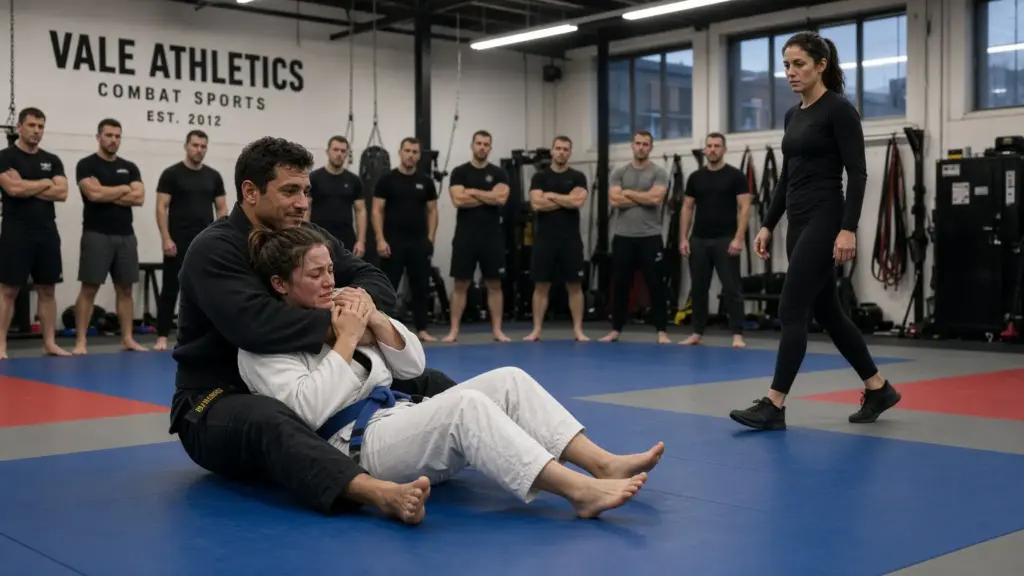
It was the first event they had been forced to name.
Across town, Hannah sat at her kitchen table reading the group messages Priya had forwarded.
She felt relief first.
Then anger.
Then something closer to grief.
She had come to Southpoint because she wanted a place to train.
Now strangers were debating policies because she had tapped and a man had refused to listen.
Part of her wanted to disappear from the story completely.
Another part wanted the monthly fee refunded and nothing else.
Then Priya sent a voice message.
“You don’t owe anyone a statement. But Daniel asked if you want to submit one privately. You can also say no. Claire said nobody should use your experience to redesign the gym without asking what you actually want.”
Hannah listened twice.
Claire said.
That mattered.
Not because Claire had been a champion.
Because Claire had been the first person in the room to tell Hannah she did not have to say she was fine.
Hannah opened a blank document.
She typed one sentence.
I tapped because I wanted the choke to stop.
Then another.
I tapped again because it did not.
Then another.
I do not want anyone punished because I was embarrassed. I want the gym to decide whether a tap is a rule or a suggestion.
She stopped.
That was enough.
The next morning, Daniel called an emergency owners’ meeting.
There were four owners.
None trained regularly anymore.
That fact became the first uncomfortable problem.
They had delegated culture without admitting they were delegating authority.
Marcus had filled the vacuum because he showed up.
He fixed broken lockers.
He collected late dues.
He opened early for competitors.
He helped organize tournaments.
He did real work.
Over time, real work had become informal power.
Informal power had become social immunity.
The Black Belt Smirked, “This Mat Isn’t for You” — Then a Calm Stranger Stepped Forward
Daniel read Hannah’s statement aloud.
Nobody defended what happened.
But disagreement began immediately after that.
One owner wanted Marcus permanently banned.
Another argued for a thirty-day suspension.
A third said they needed legal advice before taking any action.
Daniel listened.
Then he asked a different question.
“What would we do if the person on that video were someone none of us knew?”
The room went quiet.
That question became the foundation of everything that followed.
They suspended Marcus pending review.
They froze all unsupervised hard sparring.
They created a temporary rule requiring immediate release on verbal or physical tap, with suspension for deliberate violations.
They established that anyone could decline a partner without explanation.
And they asked every active member to submit anonymous safety concerns from the previous two years.
Within forty-eight hours, twenty-seven reports arrived.
Most did not mention Marcus.
That surprised everyone.
The problem was bigger than one man.
Marcus had simply become its clearest symbol.
Marcus learned about the reports from Daniel three days later.
He arrived at the meeting with an attorney.
Daniel did not object.
The owners had hired their own.
Nobody wanted the process to become another version of Southpoint’s old habit: powerful people deciding what counted based on how they felt in the moment.
Marcus listened while Daniel summarized the complaint against him. Deliberately maintaining a choke after a tap. Making a demeaning statement to a newer member during the same round. Prior concerns involving delayed releases and pressure on beginners to accept rounds they had declined.
Marcus’s first response was predictable.
“I never injured anyone.”
Daniel looked at him.
“That is not the standard.”
“It should matter.”
“It does. It is not the standard.”
Marcus’s attorney asked whether Southpoint had a written rule stating how quickly a submission had to be released.
Daniel slid a printed page across the table.
The old policy said, Upon any clear physical or verbal submission, pressure must cease immediately.
Marcus read it.
“That document hasn’t been enforced in years.”
Daniel nodded.
“You’re right.”
Marcus looked almost surprised.
Daniel continued.
“And that failure belongs to us.”
The room shifted.
Marcus had prepared for a fight in which the owners would act innocent and place everything on him.
Instead, Daniel was admitting institutional failure without removing Marcus’s individual responsibility.
“You can’t suddenly enforce a rule because somebody made a video,” Marcus said.
“We are not punishing you for a hidden rule. You told Claire yourself what the rule was.”
Marcus stared at him.
Daniel had the transcript printed.
What is the rule here about taps?
Of course there is.
What is it?
You release.
When?
Immediately.
Marcus looked away.
His attorney asked for a recess.
They took fifteen minutes.
When Marcus returned, his tone had changed slightly.
He no longer argued that the rule did not exist.
He argued intent.
“I was teaching her not to panic.”
Daniel asked, “Did she ask you to teach that lesson?”
“She agreed to roll.”
“That is not the same thing.”
“She needed to learn pressure.”
“Did she agree to continue after tapping?”
Marcus said nothing.
Daniel waited.
“No,” Marcus said eventually.
The word was quiet.
For the first time since the incident, he had said something that did not defend himself.
Daniel did not rush into the silence.
Marcus continued.
“But I still think this is being turned into something it wasn’t.”
“What do you think it was?”
“A mistake.”
The Black Belt Smirked, “This Mat Isn’t for You” — Then a Calm Stranger Stepped Forward
Daniel nodded.
“That is possible.”
Marcus looked up.
“You think I made a mistake?”
“I think a deliberate bad act and a dangerous habit can look very similar from the outside. The review is not only about what you intended. It is about what you did, what pattern existed, and what happens next.”
Marcus leaned back.
“So what happens next?”
“Seven-day extension of your suspension while we complete interviews. Then the owners decide conditions for return, if any.”
Marcus laughed bitterly.
“Conditions.”
“Yes.”
“You know how much I’ve done for this place?”
“I do.”
“Then maybe that should count.”





