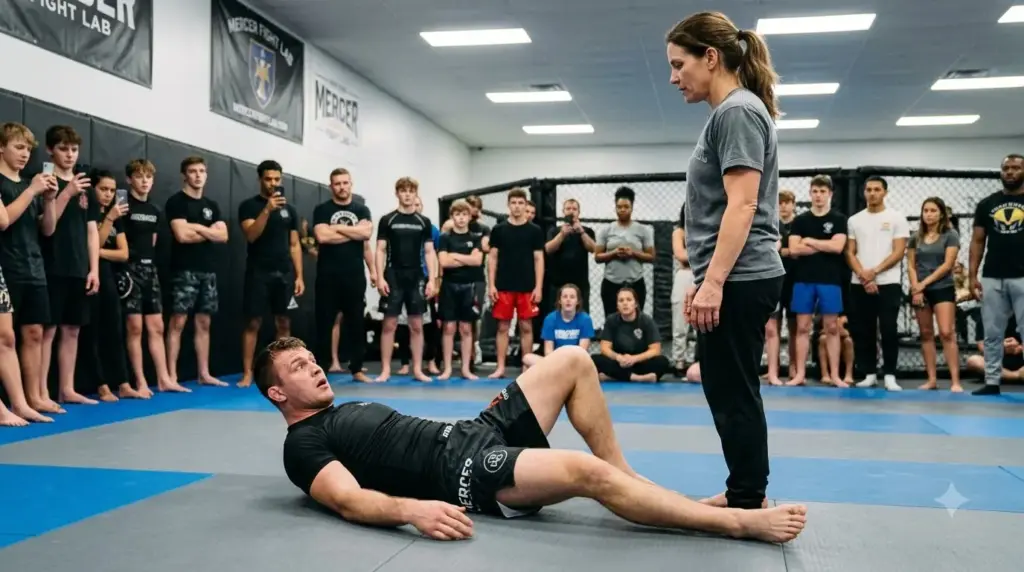
“What does that have to do with it?”
“Everything.”
She leaned forward.
“They were learning from you.”
Tyler said nothing.
“They weren’t learning grappling.”
She tapped the desk.
“They were learning that being the best fighter in the room gives you permission to make somebody smaller.”
Tyler’s face tightened.
“That wasn’t what I was doing.”
Rebecca looked at him quietly.
Tyler remembered the laughter.
Her two refusals.
His insistence.
He exhaled.
“Maybe.”
Rebecca nodded.
“Maybe is a start.”
Tyler did not get his rematch.
He asked.
Rebecca said no.
This time he accepted the answer.
A week later, he returned to Mercer Fight Lab.
Martin was coaching beginners.
Tyler waited until class ended.
“I was an idiot.”
Martin looked at him.
“That narrows down very little.”
“At the fundraiser.”
Martin nodded.
“Yes.”
Tyler smiled reluctantly.
“I apologized to Rebecca.”
“Did she forgive you?”
“She said there wasn’t anything to forgive if I learned something.”
Martin nodded.
“Sounds like Rebecca.”
“You knew her?”
“Not personally.”
“Then how?”
“Anybody serious about wrestling in that era knew the name.”
Tyler looked toward the mat.
“Why didn’t you tell me?”
Martin laughed.
“You mean before you announced you’d go easy?”
“Yes.”
“No chance.”
Tyler stared.
“That’s terrible coaching.”
“That was excellent coaching.”
For the first time, Tyler laughed too.
Training changed after that.
Not dramatically at first.
Tyler was still competitive.
Still proud.
Still dangerous on the mat.
He did not become a different person overnight.
But he began noticing things he had previously ignored.
How often younger athletes laughed when beginners struggled.
How quickly experienced fighters offered advice nobody requested.
How frequently people treated rank like a personality.
One evening, a new student named Paul arrived.
Forty-two.
Overweight.
Nervous.
Tyler partnered with him.
Paul said,
“Please go easy.”
The old Tyler would have smiled.
Maybe displayed control.
Maybe let others watch.
Instead Tyler said,
“You set the pace.”
They trained.
No humiliation.
No lecture.
No audience.
Afterward, Paul thanked him.
Tyler thought of Rebecca.
Months passed.
Then Rebecca appeared at Mercer Fight Lab again.
Not alone.
She brought twelve teenage girls.
Her wrestlers.
Martin had agreed to let them use the mats for a weekend clinic.
Tyler saw her enter.
“You came back.”
“Building survived?”
“Barely.”
She smiled.
One girl whispered,
“That’s Tyler Grant.”
Another whispered louder,
“He’s the guy Coach submitted.”
Tyler heard.
Rebecca closed her eyes.
“Teenagers.”
He laughed.
“Deserved.”
During the clinic, Tyler watched Rebecca coach.
He expected intensity.
What he saw was patience.
A girl failed the same movement six times.
Rebecca showed her seven.
Another became frustrated and cried.
Rebecca sat beside her until she was ready.
No screaming.
No humiliation.
No “toughen up.”
After practice, Tyler asked,
“You never yell?”
“Sure.”
“When?”
“Bus is leaving.”
He smiled.
“What about when they’re lazy?”
“I ask why.”
“And if they’re actually lazy?”
“Then I tell them.”
“That’s it?”
Rebecca shrugged.
“Fear makes people obey. It doesn’t always make them learn.”
That sentence changed Tyler’s coaching more than anything he had learned in a certification course.
Two years later, Tyler won the biggest championship of his career.
National television.
Five-round submission match.
He came from behind.
Won in the final minute.
Reporters crowded him afterward.
One asked,
“What changed in the last two years?”
Tyler smiled.
“Got humbled.”
The reporter assumed he meant a previous professional loss.
Tyler did not explain.
He knew.
After the championship, Tyler began coaching more.
Martin eventually offered him a partnership in the gym.
Tyler accepted.
One of the first programs he added was free mat time for local high-school wrestling teams.
Rebecca’s girls became regular visitors.
Nobody paid.
Tyler insisted.
Rebecca objected.
He told her,
“Quality control.”
She stared.
“What does that even mean?”
“Nothing.”
“Then stop saying it.”
He laughed.
By fifty, Rebecca’s knee was worse.
She could still demonstrate.
Slowly.
Carefully.
One afternoon, a thirteen-year-old wrestler named Maya asked her,
“Coach, were you really almost an Olympian?”
Rebecca looked across the gym.
Tyler was helping a beginner.
“Almost.”
“Does that bother you?”
Rebecca considered the question.
“Less than it used to.”
“Why?”
She pointed toward the girls training.
“Because life got larger.”
Maya frowned.
Rebecca smiled.
“When I was twenty-three, the biggest thing in the world was winning.”
She looked around.
“Turns out the world is bigger than that.”
Years later, the fourteen-second video still circulated occasionally.
Tyler hated it at first.
Eventually he kept a copy on his phone.
Not to watch often.
To remember.
The clip contained no great secret technique.
No magical upset.
No impossible strength.
It captured something simpler.
A champion who believed everybody around him existed inside his hierarchy.
A woman who did not.
Rebecca had not beaten Tyler because belts were meaningless.
They were not.
Skill mattered.
Training mattered.
Competition mattered.
She beat him because he entered the exchange trying to demonstrate superiority while she entered it understanding balance, timing, and what he was about to do.
More importantly, Rebecca could have humiliated him further.
She did not.
She could have injured him.
She stopped the instant he tapped.
She could have spent years telling the story.
She rarely mentioned it.
Tyler eventually realized that was the difference between them.
He needed the room to know he was dangerous.
Rebecca had spent enough of her life proving things to herself.
She needed nothing from the audience.
When Tyler turned forty, Mercer Fight Lab hosted an anniversary event.
Former fighters returned.
Students brought families.
Rebecca came with both brothers she had helped raise decades earlier.
One of them, Daniel, looked at Tyler.
“So you’re the guy?”
Tyler laughed.
“I’m afraid to ask.”
“The ‘go easy’ guy.”
Rebecca covered her face.
“I hate the internet.”
Daniel shook Tyler’s hand.
“She did worse to me when I stole her car at sixteen.”
Tyler stared.
Rebecca pointed at her brother.
“Do not finish that story.”
Everyone laughed.
Tyler looked around the room.
This time the laughter did not bother him.
That was how he knew he had changed.





