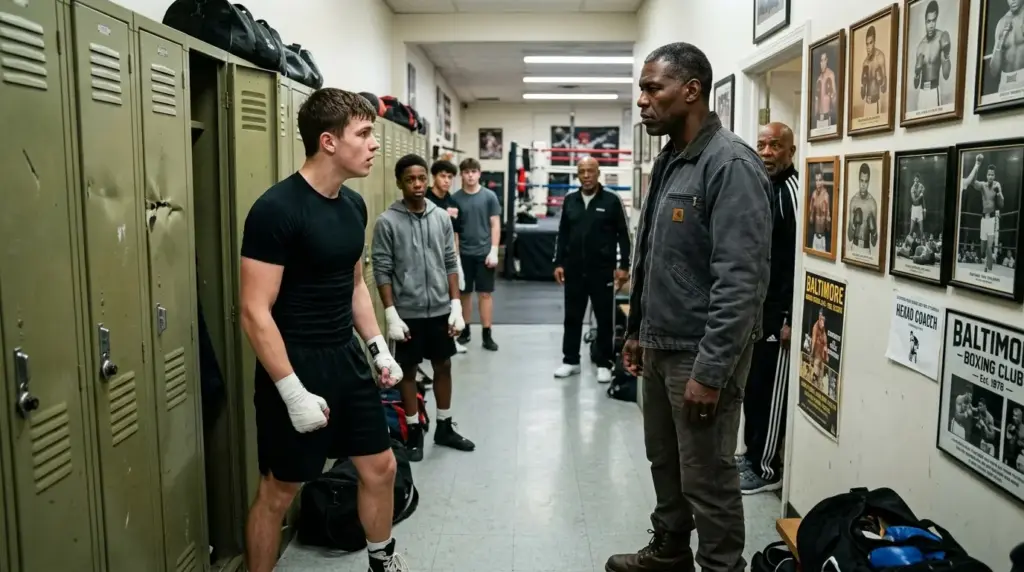
MARCUS “STONE” WALKER — NATIONAL LIGHT HEAVYWEIGHT CHAMPION — 2006
Damon looked again.
Then slowly turned toward the man in the work jacket.
“No way.”
Kyle moved closer to the photograph.
“That’s him?”
Leonard nodded.
Marcus looked irritated.
“This isn’t helping.”
But Leonard continued.
“Twenty-three professional wins.”
Marcus said:
“Leonard.”
“Seventeen by knockout.”
“Enough.”
“National champion.”
Damon stared.
He knew the name now.
Marcus “Stone” Walker.
There were old fight clips online.
A pressure fighter with frightening body punches and an unusual ability to stay calm while opponents tried to intimidate him.
Damon had actually watched one of his fights months earlier without connecting the name to Ethan.
The fighter in those clips had shaved hair, a younger face, and an expression that looked carved from concrete.
This Marcus Walker had grocery receipts sticking from his pocket.
Damon swallowed.
“Why does Ethan never say anything?”
Marcus answered.
“Because it’s not his accomplishment.”
That ended the conversation.
In the car, Ethan waited until they were three blocks away before speaking.
“You embarrassed me.”
Marcus kept his eyes on the road.
“How?”
“Everybody knows now.”
“Knows what?”
“Who you are.”
Marcus glanced at him.
“Who I was.”
“Same thing.”
“No.”
Marcus turned onto North Avenue.
“It isn’t.”
Ethan stared out the window.
Rain had started tapping lightly against the glass.
After a minute, Marcus asked:
“How long?”
Ethan knew exactly what he meant.
“Nothing happened.”
“That wasn’t the question.”
Ethan sighed.
“Couple weeks.”
Marcus’s hands tightened slightly around the steering wheel.
“You didn’t tell me.”
“I handled it.”
“You were cornered in a locker room.”
“I didn’t fight.”
“I’m proud of that.”
Ethan looked over.
“Then what’s the problem?”
“The problem is you thought handling something meant hiding it.”
Ethan looked away.
Marcus continued.
“Why didn’t you tell Coach Leonard?”
“He knows Damon’s rough.”
“That isn’t what I asked.”
Ethan stayed silent.
Marcus waited.
Finally Ethan said:
“Damon wins.”
“What does that mean?”
“Coach likes him.”
Marcus frowned.
“He’s one of the best juniors.”
“So?”
“So if I complained, I’d be the kid who couldn’t handle boxing.”
Marcus exhaled slowly.
That answer bothered him more than anything Damon had said.
“Did someone tell you that?”
“No.”
“You assumed.”
Ethan shrugged.
“Everybody knows.”
Marcus pulled into the parking lot of their apartment building and turned off the engine.
Neither moved.
Then Marcus said:
“When I was seventeen, I trained with a guy named Calvin Ross.”
Ethan had heard many of his father’s fight stories.
Not this one.
“Who?”
“Regional amateur champion.”
“Good?”
“Very.”
Marcus leaned back.
“Also mean.”
Ethan listened.
“Calvin liked hurting people in sparring.”
“Coach let him?”
“For too long.”
“Why?”
“Because he won.”
Marcus looked at him.
“Same mistake.”
Ethan became quiet.
“One day he broke a kid’s nose during what was supposed to be technical work.”
“What happened?”
“My coach finally threw him out.”
“Did Calvin fight somewhere else?”
“Yes.”
“Did he become champion?”
Marcus shook his head.
“He got better physically and worse everywhere else.”
“What happened to him?”
Marcus looked through the windshield.
“Never learned the difference between being feared and being respected.”
That answer stayed with Ethan.
Marcus Walker had not always been the kind of father who arrived carrying groceries.
Once, arenas had announced his name.
Crowds had shouted it.
At twenty-two, he won the national Golden Gloves at light heavyweight.
At twenty-five, he was 14–0 as a professional.
At twenty-eight, he won a national championship in a twelve-round fight still replayed on local sports television.
He was never a global superstar.
Never made hundreds of millions.
But in Baltimore boxing circles, Marcus Walker mattered.
Then his life changed.
Not in the ring.
At home.
Ethan’s mother, Danielle, was diagnosed with an aggressive form of leukemia when Ethan was six.
Marcus was thirty-four.
Still good enough to fight.
Still receiving offers.
He walked away from boxing.
Not ceremonially.
No retirement tour.
He simply stopped taking fights.
Hospitals replaced gyms.
Medication schedules replaced training camps.
He spent two years caring for Danielle.
She died when Ethan was eight.
Afterward, Marcus worked wherever stability existed.
First as a gym trainer.
Then with the city parks department.
Eventually as a maintenance supervisor for Baltimore recreation centers.
He still boxed sometimes.
Still coached privately.
But he refused every offer to build a career around his old name.
Ethan once asked why.
Marcus answered:
“Because being good at hitting people was one part of my life. It doesn’t get to own the rest.”
That was why Ethan rarely talked about him.
At school, Marcus was just Dad.
At the gym, most younger fighters assumed he was another parent.
Ethan preferred it.
Until Thursday night.
The next afternoon, Coach Leonard called Marcus.
“I suspended Damon.”
Marcus stood in a maintenance room replacing a broken light fixture.
“For how long?”
“One week.”
Marcus stopped working.
“That’s not enough.”
“I knew you’d say that.”
“Then why call?”
“Because I want your opinion.”
Marcus sighed.
“You want my real opinion?”
“Yes.”
“Suspending one kid doesn’t fix the room.”
Leonard became quiet.
Marcus continued.
“Three boys blocked a fifteen-year-old in your locker room.”
“I know.”
“He didn’t report it because he thought winning mattered more to you than safety.”
“That part isn’t fair.”
“Doesn’t matter.”
Leonard stiffened.
“Excuse me?”
“If that’s what your students believe, your intention is irrelevant.”
Silence.
Marcus had learned that from boxing too.
Results mattered.
Leonard finally said:
“What do you suggest?”
“Talk to the kids.”
“I do.”
“No.”
Marcus shook his head.
“Ask them.”
“Ask what?”
“Who they avoid.”
“Who they don’t trust.”
“Who changes pace after getting embarrassed.”
“Who makes them feel like saying no will make them look weak.”
Leonard did not answer.
Marcus added:
“And ask without the senior fighters in the room.”
The answers were worse than Leonard expected.
Damon was not the only problem.
He was simply the loudest.
Two older teenagers had been turning technical rounds into competitions.
Beginners felt pressured to accept sparring partners.
Several kids believed refusing a round made them look cowardly.





