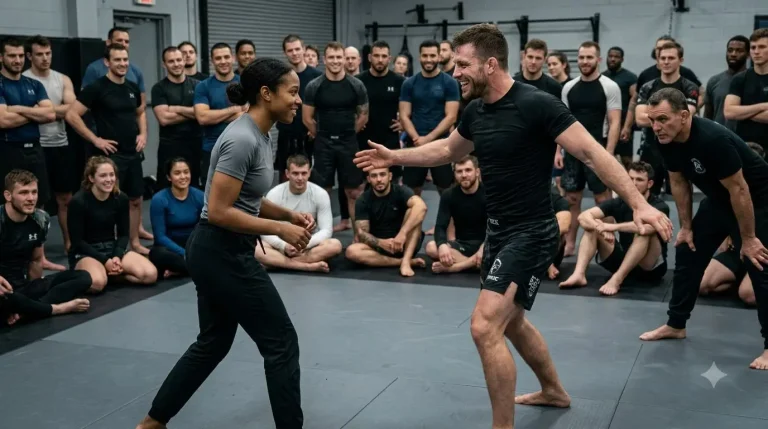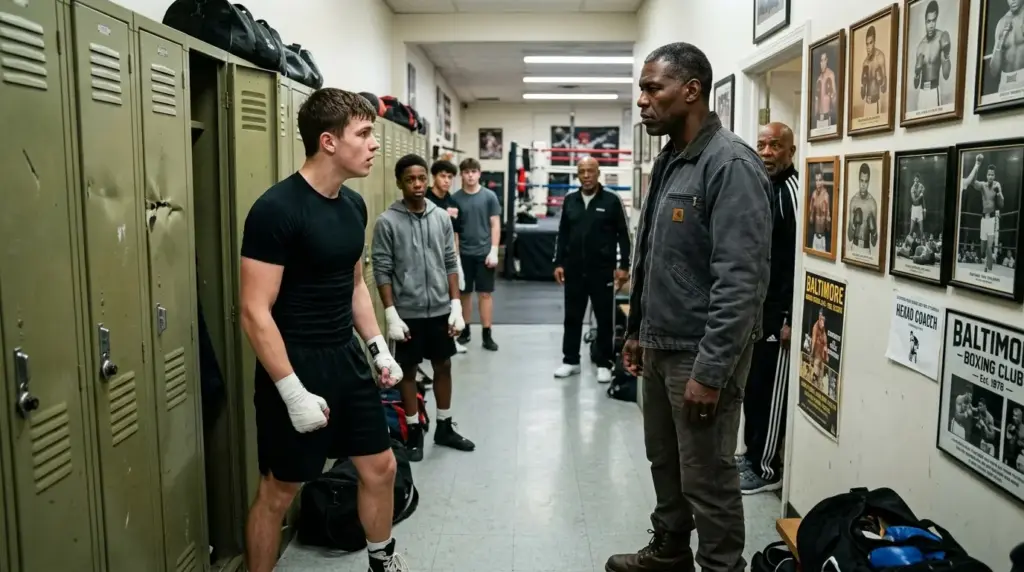
Near the end of the night, Leonard stood beneath the photograph wall.
“I almost ruined this place.”
People protested.
He raised one hand.
“No.”
He looked toward Marcus.
“There was a period where I cared too much about producing winners.”
“I told myself everything else would follow.”
He looked at Damon.
“It didn’t.”
Damon nodded.
Leonard continued.
“A gym isn’t healthy because the strongest people feel powerful.”
He pointed toward several younger students.
“It’s healthy when the weakest person can say stop and expect the room to listen.”
Marcus smiled.
That was the lesson.
Years earlier, three teenagers had blocked a locker-room door.
They thought the story was about who could fight.
Damon believed Ethan was weak because he would not accept an angry sparring challenge.
He believed Marcus’s absence proved Ethan was alone.
Then the door opened.
A former champion walked in.
For a moment, everyone thought that was the twist.
It wasn’t.
Marcus Walker never touched Damon.
Never threatened him.
Never used his old championship to make a frightened teenager smaller.
He did something harder.
He demanded that the gym look at why Ethan had needed rescuing in the first place.
And then he stepped back enough for the boys to change.
That was why, decades later, when Ethan told his own children the story, he never ended with:
Then my dad walked in.
He ended with what Marcus said afterward.
My job is to help you become the kind of man who doesn’t need me standing in every doorway.
Ethan eventually understood.
A good father could protect his child.
A better father also taught him that protection was not the same as power.
Sometimes protection meant fighting.
Sometimes it meant leaving.
Sometimes it meant speaking.
Sometimes it meant refusing.
And sometimes it meant walking through a door, looking at everyone in the room, and making one thing perfectly clear:
A boy should not need a champion for a father before his no is enough.