Nia felt all of it.
She preferred the jokes.
At least contempt was honest.
Reverence from strangers was just another way of being treated like an object.
Daniel understood within minutes.
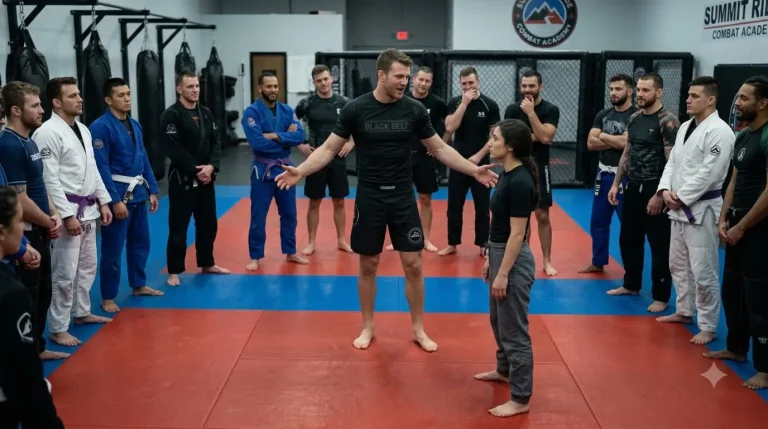
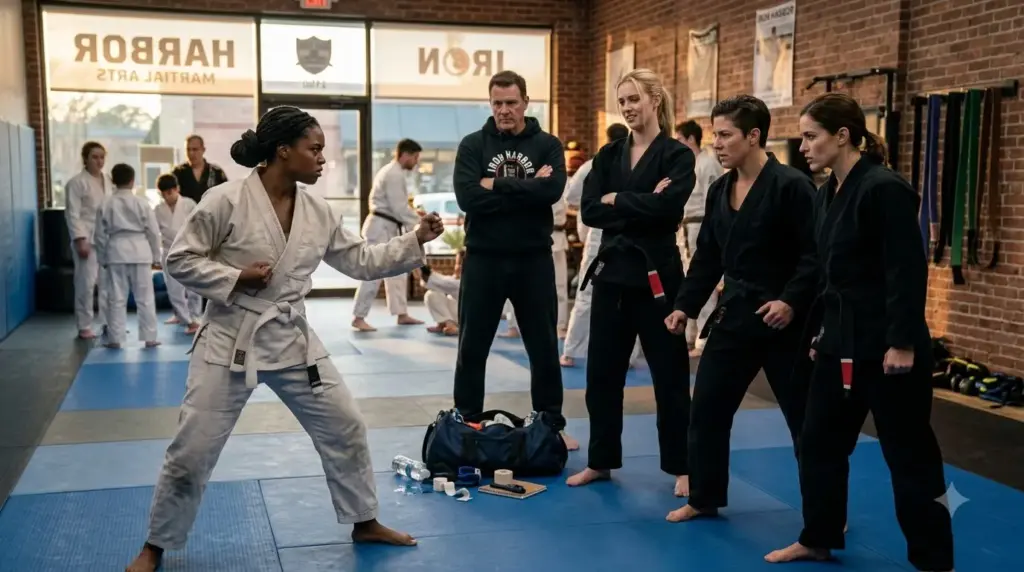
He called everyone into a circle before warmups.
“One thing before we start,” he said. “Nobody in this room is a museum exhibit. Nobody gets special treatment because you found an old tournament result online. If you have a question for Nia, ask her like a person. If she doesn’t want to answer, move on. We train.”
Several students looked away guiltily.
Nia glanced at Daniel.
“Thank you.”
He nodded once.
Madison arrived a minute later.
She saw Nia, stopped briefly, then walked over.
“Hi.”
“Hi.”
“I’m not going to apologize again.”
Nia blinked.
“Good.”
Madison gave a nervous half smile.
“I figured I’d try behaving differently instead.”
“That usually works better.”
Madison nodded toward the white belt.
“You really keeping that?”
“For now.”
“Okay.”
She left it there.
Three Black Belts Called Her a Rookie — Then Their Coach Quietly Said, “Look Again.”
That small decision mattered more than Nia expected.
Brooke arrived carrying two coffees and offered one to Tessa. Tessa took it but remained quieter than usual. She had spent most of Wednesday night searching Nia’s name online.
The search had not been difficult.
Nia Carter, age nineteen: brown belt national medalist.
Nia Carter, age twenty: promoted to black belt by Leon Price after winning the East Coast Invitational.
Nia Carter, age twenty: Atlantic Open finalist.
Then the video.
Tessa had watched it six times.
The final lasted one minute and forty-seven seconds.
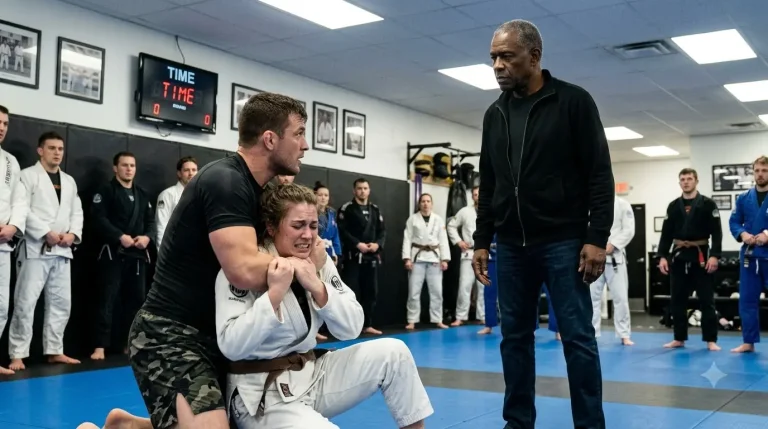
Nia’s opponent, Sofia Mendes, attacked aggressively from standing. They exchanged grips. Sofia attempted a throw. Nia countered. They hit the floor in a scramble. Sofia’s leg became entangled during the transition. Nia shifted her hips to clear position.
Sofia’s knee buckled.
The sound was faint on the recording, but the crowd reaction was not.
The referee stopped the match immediately.
Nia backed away before he touched her.
Then she sat down ten feet away and stared at her own hands.
Tessa had expected the comments below the video to explain things.
They made everything worse.
Some called Nia dirty.
Some blamed Sofia for refusing to concede position.
Some praised the technique.
Others accused everyone involved of racism, favoritism, incompetence, cowardice, arrogance, or worse. Most commenters wrote with total certainty despite disagreeing about what had actually happened.
Tessa found a later interview with Sofia.
She watched that twice.
Sofia said clearly that Nia had done nothing illegal.
She said the injury happened in transition.
She said she had never blamed Nia.
Then the interviewer asked whether the two had spoken afterward.
Sofia looked away.
“No,” she said. “I tried. She disappeared.”
That sentence bothered Tessa more than the injury.
Not because it made Nia guilty.
Because Tessa recognized the instinct.
When shame became unbearable, Tessa also disappeared.
Not from whole sports. From conversations. From friendships. From any room where she might have to admit that the person she wanted to be and the person she had been were not the same.
Thursday’s class focused on guard retention.
Daniel paired Nia with Tessa.
Tessa almost asked to switch.
Instead, she sat down across from her.
“Can I ask you something before we start?”
Nia’s shoulders tightened.
“Depends.”
“I watched the Sofia match.”
Nia’s eyes dropped for one second.
Tessa immediately regretted opening with it.
“I’m not asking what happened,” she said quickly. “I saw what happened.”
Nia looked back up.
“Then what are you asking?”
“Why didn’t you talk to her after?”
The timer had not started yet.
Around them, other pairs were settling into position.
Nia looked toward Daniel.
He was adjusting the wall timer and not listening.
“I tried the first night,” Nia said. “Hospital wouldn’t let me in because I wasn’t family. I texted the next morning. Her coach replied and said she needed space.”
Tessa waited.
“A week later Sofia texted me herself. I read it and didn’t answer.”
“Why?”
“Because by then I’d read a thousand people telling me what kind of person I was.”
“That doesn’t sound like Sofia’s fault.”
“It wasn’t.”
Nia rubbed her thumb over the tape on her index finger.
“I told myself I was respecting her space. Really I was afraid she’d say she hated me, and I was even more afraid she’d say she didn’t.”
Tessa frowned.
“Why would that be worse?”
“Because then I’d have to accept that maybe the person punishing me was me.”
The timer beeped.
Daniel called, “Go.”
Nia lay back and brought her knees in.
Tessa stood over her.
Neither moved for a beat.
Then Tessa said, “That sounds exhausting.”
Nia gave a tiny smile.
“It was.”
Tessa stepped forward.
They trained.
Three Black Belts Called Her a Rookie — Then Their Coach Quietly Said, “Look Again.”
The conversation did not make them friends.
But it changed the temperature between them.
Over the next three weeks, Nia kept returning.
Tuesday and Thursday evenings.
Sometimes Saturday morning.
She remained in the white belt.
Daniel stopped commenting on it.
The students slowly stopped caring.
That was exactly what Nia needed.
Her timing returned before her conditioning did.
After four years away, she could see openings she could no longer physically chase. The first time that happened, she laughed in the middle of a round with Brooke.
Brooke sat back.
“What?”
“My brain just tried to do something my lungs voted against.”
Brooke grinned.
“Welcome to being mortal.”
“I don’t remember approving this.”
“None of us do.”
They both laughed.
That too mattered.
For years, every memory Nia had of jiu-jitsu was connected to competition footage, comment sections, hospital lights, and the sensation of hearing someone scream while her own hands were still gripping fabric.
Iron Harbor slowly gave the sport back to her in smaller pieces.
A bad joke during warmups.
A round where nothing important happened.
Helping Eli learn how to stop crossing his feet from the back.