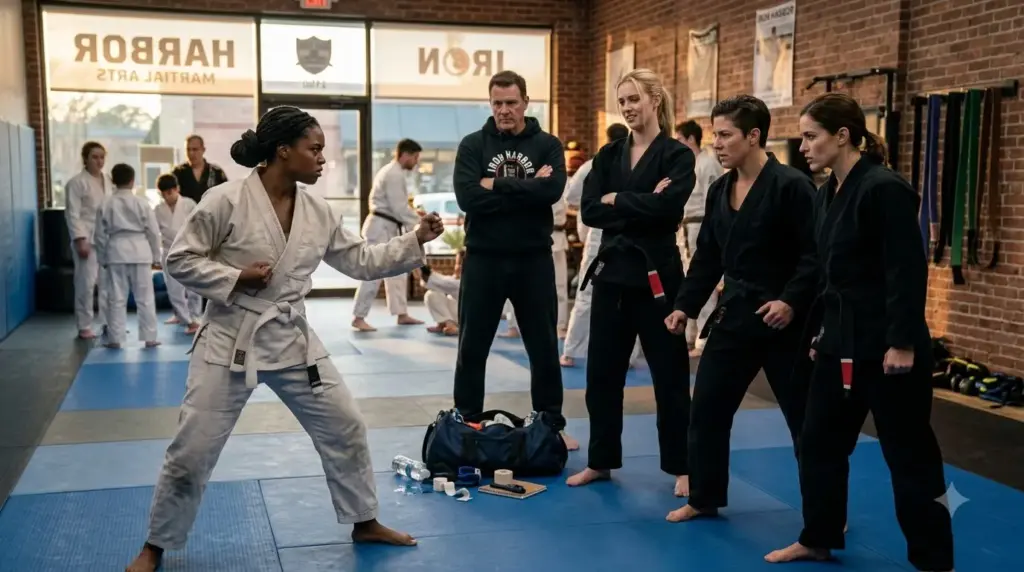
A surprised laugh escaped Nia.
“Okay. Fair.”
Madison smiled cautiously.
Nia continued, “I mean I don’t need you to stop because of me. I need you to ask better questions before you start.”
“I can do that.”
“And maybe check the background.”
“Definitely doing that.”
Nia’s expression softened.
“I’m still mad.”
“You should be.”
“That answer is annoying.”
“I’m trying very hard not to make this worse.”
“You’re succeeding by a narrow margin.”
They both smiled.
It was not forgiveness.
But it was movement.
Two weeks later, Iron Harbor announced its annual in-house technical showcase.
The event was not a tournament. Daniel hated the way ordinary gym competitions sometimes turned teammates into enemies for a plastic medal. Instead, the showcase paired students for controlled rounds in front of friends and family, followed by demonstrations, promotion announcements, and a charity fundraiser for a local youth sports program.
Madison loved the event.
Brooke tolerated it.
Tessa treated it like the Olympics.
Nia planned to skip it.
Then Daniel asked her to stay after class.
They sat on the edge of the mat while Eli vacuumed the lobby.
“I need a favor,” Daniel said.
Nia narrowed her eyes.
“That sounds dangerous.”
“Probably not.”
“What?”
“I have six teenage girls in the youth program. They’ve been asking if we can add a women’s self-defense segment to the showcase.”
“You have black belts.”
“I do.”
Nia waited.
Daniel continued, “I want you to help design it.”
“No.”
He nodded.
“All right.”
Nia stared at him.
“That’s it?”
“You said no.”
“You’re not going to tell me it would be good for me?”
“No.”
“Or that I owe the gym?”
“No.”
“Or that the girls need a role model?”
Daniel winced.
“I would rather eat the mop than say that sentence to you.”
Nia laughed despite herself.
Daniel leaned back on his hands.
“For what it’s worth, I didn’t ask because you’re a former champion.”
“Why did you ask?”
“Because you’ve spent six weeks stopping rounds before people get hurt. Self-defense instruction should start with judgment, not moves.”
Nia looked down at the mat.
That answer stayed with her.
The next morning she texted him.
I’ll help design it. I’m not demonstrating.
Three Black Belts Called Her a Rookie — Then Their Coach Quietly Said, “Look Again.”
Daniel replied: Deal.
She designed the segment with Madison, Brooke, and Tessa.
That was where their relationships began to change for real.
Not because of dramatic apologies.
Because planning exposed habits.
Madison initially wanted to demonstrate several impressive takedowns.
Nia crossed half of them out.
“Why?” Madison asked.
“Because the audience will remember the spectacular thing and forget the useful thing.”
“It’s a showcase.”
“It’s labeled self-defense.”
“So?”
“So if a hundred people go home thinking the first answer to danger is to clinch with someone larger than them, we taught badly.”
Brooke nodded.
“She’s right.”
Madison sighed.
“I hate when that happens.”
Tessa suggested a knife-disarm sequence she had learned at a seminar.
Nia asked, “Have you pressure-tested it?”
Tessa frowned.
“We drilled it.”
“That’s not what I asked.”
Tessa looked offended.
Nia held up both hands.
“I’m not saying it’s fake. I’m asking whether you’ve tried it against someone actively resisting while protecting the weapon hand.”
“No.”
“Then we don’t teach it to parents in folding chairs like it’s guaranteed.”
Tessa leaned back.
“You’re very good at ruining exciting ideas.”
Nia smiled.
“That’s why Coach asked me.”
Brooke laughed.
They built the segment around awareness, verbal boundaries, creating distance, protecting the head, escaping common grips, getting up from the ground, and leaving.
Simple things.
Things that did not look cinematic.
Things people could remember under stress.
During rehearsal, one of the teenage students, a thirteen-year-old named Jasmine, asked Nia why she wore a white belt if she knew more than the black belts.
The entire room went quiet.
Nia crouched so they were closer to eye level.
“I don’t know more than all of them.”
Jasmine pointed at Madison.
“You beat her.”
Madison called from across the mat, “Thank you, Jasmine. Very healing.”
Everyone laughed.
Nia smiled.
“Winning a round doesn’t mean you know more. It means something worked in that round.”
Jasmine looked unconvinced.
“But you were a black belt before, right?”
“Yes.”
“So why white now?”
Nia thought carefully.
“Because when I came back, I didn’t trust myself yet.”
Jasmine tilted her head.
“Did the white belt make you safer?”
The question struck deeper than the child intended.
Nia looked at the belt around her waist.
“No,” she said slowly. “I think it made me feel like I was allowed to be unsure.”
Daniel, standing near the office, heard that.
So did Madison.
Jasmine nodded as if the answer made perfect sense.
“Are you still unsure?”
Nia smiled.
“About lots of things.”
“Then you should keep it.”
Madison laughed.
“There. Promotion problem solved.”
Nia stood.
“Thank you, Professor Jasmine.”
The showcase arrived on a cold Saturday in November.
More than a hundred people filled Iron Harbor. Folding chairs lined the wall. Parents carried coffee. Children chased each other until Daniel threatened to make them do sprawls. A table near the entrance collected donations for the youth sports fund.
Nia wore black athletic pants and an Iron Harbor T-shirt, not a gi.
She planned to remain behind the scenes.
For most of the afternoon, she did.
Then one of the teenage demonstrators twisted an ankle during warmups.
Three Black Belts Called Her a Rookie — Then Their Coach Quietly Said, “Look Again.”
Not badly.
But badly enough to sit out.
Daniel came to Nia.
She saw the question before he spoke.
“No.”
“I haven’t asked yet.”
“You made the face.”
“What face?”
“The reasonable-coach face.”
“I only have one face.”
“Daniel.”
“We need one person to fill the last station. You designed the sequence.”
“Use Madison.”
“She’s already at station two.”
“Brooke.”
“Station four.”
“Tessa.”
“Working the safety table.”
Nia looked around.
Daniel waited.
She exhaled.
“Five minutes.”
“Five minutes.”
“No introduction.”
“Fine.”
“No old footage.”





