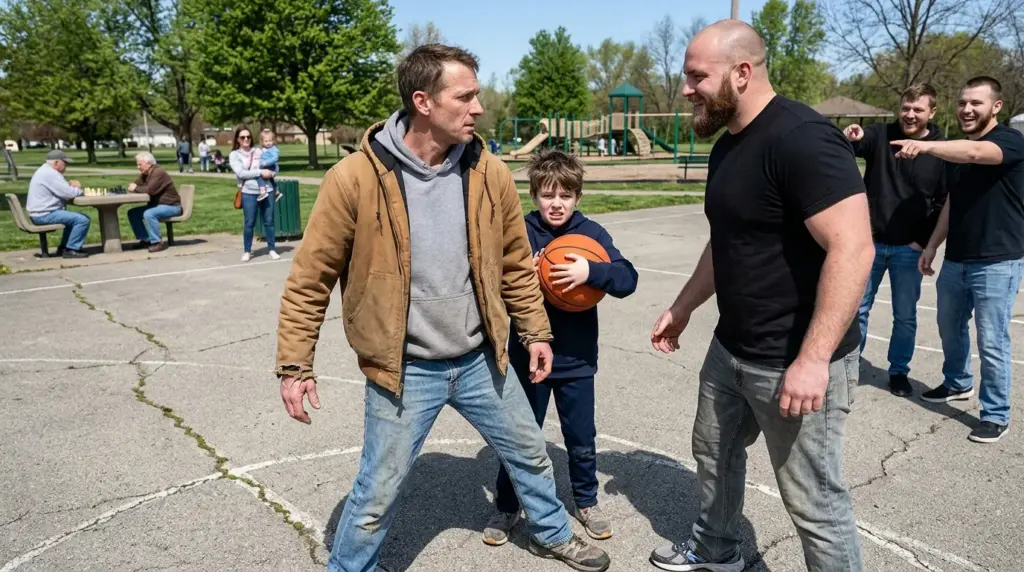
The first shove was meant to be funny.
That was what made it so ugly.
Not hard enough to injure.
Not dramatic enough to look like an attack if anyone tried to explain it later.
Just a quick push against the chest of a quiet man standing beside a park bench, the kind of shove men use when they want humiliation but not consequences.
The quiet dad took one step back.
His son froze beside him.
The three men laughed.
And for a moment, everyone at Riverside Park in Franklin, Ohio, pretended not to see.
That was how bullying survived in public places.
Not because no one noticed.
Because noticing required a decision.
The father’s name was Ethan Cole.
He was forty-two years old, lean, clean-shaven, with tired blue eyes and hands that looked more suited to repairing engines than making fists. He wore faded jeans, a gray hoodie, and a brown canvas jacket with one torn cuff. His hair was cut short, not stylish, just practical.
He did not look dangerous.
He did not look important.
He looked like a man who packed school lunches, changed his own oil, paid bills late but honestly, and apologized when someone else bumped into him.
His twelve-year-old son, Noah, stood at his side holding a basketball against his hip.
Noah was small for his age, narrow-shouldered and serious, with brown hair that always fell into his eyes no matter how often Ethan reminded him to brush it back. He had inherited his mother’s soft face and his father’s habit of watching a room before entering it.
That habit had grown stronger over the last year.
Too strong.
Ethan hated that.
He had brought Noah to the park that Saturday morning because the boy had stopped wanting to play anywhere crowded. He ate lunch alone at school. He walked with his shoulders pulled in. He answered questions in the smallest possible voice. He had started saying “it’s fine” about things that were not fine.
A father knows when his child is shrinking.
Ethan had not known how to fix it.
So he started small.
“Let’s shoot around,” he had said that morning.
Noah shrugged.
“Maybe.”
Ethan took that as yes.
Riverside Park was busy because spring had finally pushed the worst of winter out of town. Kids climbed the red-and-yellow playground. Parents sat with coffee cups near the picnic tables. Two older men played chess beneath the pavilion. A group of teenagers practiced skateboard tricks near the path. The basketball court sat just beyond the playground, cracked but usable, with one hoop tilted slightly to the left.
For the first twenty minutes, everything was good.
Not perfect.
Good.
Noah missed most of his shots, but he smiled twice.
Ethan rebounded, passed gently, and pretended not to notice how carefully Noah checked the court every time someone walked past.
“Bend your knees,” Ethan said.
“I am.”
“Those are not bent knees. Those are knees thinking about bending.”
Noah rolled his eyes, but he laughed.
That laugh was why Ethan came.
Then the three men arrived.
They were not boys, though they acted like it.
Late twenties, maybe early thirties.
Old enough to know better.
Young enough to believe cruelty was still charisma.
The tallest was named Bryce Keller. Ethan knew him by reputation, not friendship. Bryce had played football at Franklin High, then at a small college for less than one season before coming home with bad knees, a bigger temper, and stories that grew more impressive every time he told them. He had a thick beard, a shaved head, and a body built from gym mirrors and unfinished anger.
With him were Cody Vance and Marcus Pell.
Cody was wiry, loud, always moving, always laughing half a second too early at his own jokes. Marcus was heavier, broad through the waist and shoulders, with a red face and a habit of standing too close.
They carried no basketball.
That was the first sign.
They were not there to play.
They were there to own space.
Bryce stepped onto the court while Noah was lining up a free throw.
“Little man,” Bryce called, “you planning to shoot sometime today?”
Noah stiffened.
The ball left his hands too quickly and hit the front of the rim.
Cody laughed.
“Brick.”
Marcus clapped once, slow and mocking.
Ethan caught the rebound and passed it back to his son.
“Try again,” he said quietly.
Bryce looked at Ethan.
“Court’s not daycare, man.”
Ethan turned.
His voice was calm.
“There’s plenty of room.”
Bryce smiled.
That smile said he had found something to push.
“We need full court.”
“There are two hoops,” Ethan said.
“There’s one good hoop.”
Ethan glanced at the tilted hoop on the far side, then back.
“We’ll move after a few shots.”
Bryce stepped closer.
“I didn’t ask for a schedule.”
Noah held the ball tightly against his stomach.
Ethan saw his son’s fingers digging into the rubber.
He saw the old fear return to the boy’s face.
The same fear he had seen after school when Noah claimed he had tripped even though the bruise on his shoulder looked like fingers.
The same fear he had seen when a group of older boys at the bus stop laughed and Noah suddenly decided he wanted to walk three blocks out of the way.
The same fear that had made his son quieter and quieter until even joy seemed like something he had to request permission for.
Ethan took one slow breath.
Then he stepped between Noah and the three men.
“We’re leaving,” he said.
Noah looked up quickly.
“Dad—”
“It’s all right.”
Cody laughed.
“That’s right. Take your kid and go.”
Marcus leaned toward Noah.
“Tell your daddy thanks for saving you.”
Noah’s face went red.
That was when Bryce shoved Ethan.
One hand.
Hard enough to move him.
Light enough to pretend.
Ethan’s heel scraped against the court.
Noah gasped.
The three men laughed.
A few people near the playground looked over.





