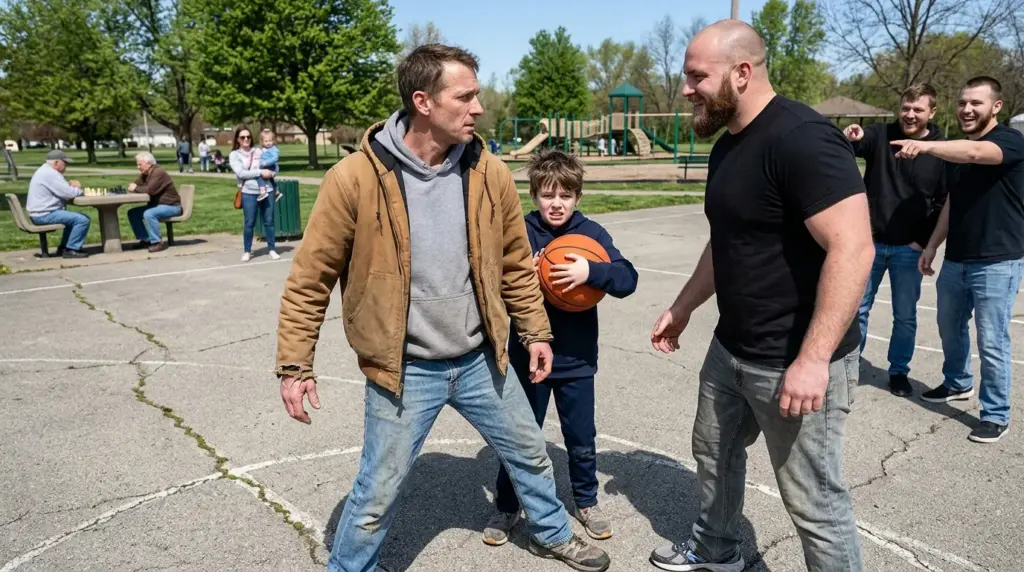
No one punched anything the first night.
A few kids complained.
They came back anyway.
By the fourth week, there were nineteen students.
By the sixth, parents asked if Ethan would start an adult class.
By the eighth, he did.
He called it Standing Room because Mrs. Harris rejected his first choice, “Thursday Safety Class,” as boring enough to cause medical fatigue.
Standing Room became less a martial arts program than a place where people learned to inhabit their bodies again.
Kids who had been bullied.
Women rebuilding confidence after bad relationships.
Older men embarrassed by fear after robberies or injuries.
Teenagers who needed a place to put anger before anger decided where to go.
Ethan taught them all the same first lesson.
“You do not train so you can start trouble,” he said. “You train so trouble does not get to choose who you become.”
Noah changed inside that room.
Not quickly.
Not like a movie.
But steadily.
He stood taller.
His voice grew clearer.
He started passing the basketball to other kids at the park.
He told his father about bad days before they became secrets.
He still got scared.
But fear stopped being the only voice in his body.
One evening after class, he stayed to help Ethan stack mats.
“Dad?”
“Yeah?”
“Were Grandpa’s shoves like Bryce’s?”
Ethan went still.
He had never told Noah many details about his own father.
Children deserve roots, but not every root needs to be handed to them like a knife.
“What makes you ask?”
Noah shrugged.
“You looked different when Bryce pushed you.”
Ethan sat on a folded mat.
Noah sat beside him.
For a long moment, Ethan listened to the building settle around them.
Then he said, “My father was angry a lot. When I was young, I thought strong meant being the person everyone was afraid of.”
Noah looked at him.
“What changed?”
“Lenny.”
“The gym guy?”
Ethan smiled faintly.
“The gym guy. He told me if I used training to become another version of my father, he would throw me out and never let me back in.”
“Did you?”
“Almost.”
Noah waited.
Ethan continued, “That is why I don’t like when people call that video cool. It is not cool to have to stop someone. It is necessary sometimes. But necessary is not the same as cool.”
Noah nodded slowly.
“Did you want to hurt Bryce?”
Ethan answered honestly.
“Yes.”
The boy’s eyes widened.
Ethan looked at him.
“That is why control matters. Good people still feel anger. Training does not remove that. It gives you a place to put it until you can choose what to do.”
Noah looked at the mats.
“I was glad you didn’t hurt him.”
“Me too.”
That was one of the moments Ethan would remember years later.
Not Bryce falling.
Not the video.
Not the laughter stopping.
That quiet conversation with his son in a room full of old mats and buzzing lights.
Because that was where the real work happened.
Not in proving strength.
In explaining restraint.
Bryce Keller did not disappear from town.
People like Bryce rarely do.
For a while, he avoided Ethan.
Then he mocked the video, claiming he slipped.
Then he got angry when people laughed.
Then, months later, he showed up at Standing Room.
Ethan saw him through the community center window and nearly locked the door.
Noah was inside helping a younger student tie his shoe.
Mrs. Harris sat near the wall with a clipboard.
Bryce entered slowly, wearing a ball cap low over his eyes.
The room went quiet.
Ethan walked toward him.
“Class is for registered students.”
Bryce nodded.
“I know.”
Ethan waited.
Bryce looked smaller than he had at the park.
Not physically.
Something else.
“My nephew wants to come,” Bryce said.
Ethan said nothing.
Bryce swallowed.
“He’s getting messed with at school. My sister asked me to bring him.”
“Where is he?”
“In the car. He didn’t want to come in if you said no.”
Ethan looked at him.
The easy answer was no.
The satisfying answer was no.
The protective answer might have been no.
But life had taught Ethan that people were not only the worst thing they had done, even when that worst thing still deserved consequence.
“Your nephew can come in,” Ethan said.
Bryce’s shoulders loosened.
“Thanks.”
“I said your nephew.”
Bryce looked up.
Ethan held his gaze.
“If you stay, you sit near the door and you do not make jokes. You do not talk over kids. You do not turn this into a performance. This room is not yours.”
Bryce nodded.
“I understand.”
“Do you?”
Bryce looked toward Noah.
Then back at Ethan.
“I’m trying to.”
His nephew joined.
A quiet boy named Lucas who stared at the floor and flinched when other kids moved too fast.
Bryce sat near the door every Thursday for three months.
At first, nobody trusted him.
That was fair.
Trust is not owed because someone regrets consequences.
But he kept showing up.
He stayed quiet.
He carried mats.
One night after class, he approached Noah while Ethan watched from across the room.
Bryce removed his cap.
“I owe you an apology,” he said.
Noah looked at him carefully.
“For what?”
Bryce seemed surprised by the question.
Maybe he had expected to apologize generally, vaguely, cheaply.
Noah made him be specific.
Bryce took a breath.
“For shoving your dad. For laughing. For trying to make him look weak in front of you.”
Noah looked down at the mat.
Then back up.
“You didn’t.”
Bryce nodded.
“No. I made myself look weak.”
Noah did not forgive him out loud.
He did not have to.
He said only, “Don’t do it again.”
Bryce nodded.
“I won’t.”
That was enough for that day.
Years passed.
Standing Room grew.
Not into a franchise.
Not into a famous gym.
Just a trusted room in a small Ohio town where people learned how to stand, breathe, speak, move, leave, and protect without becoming cruel.





