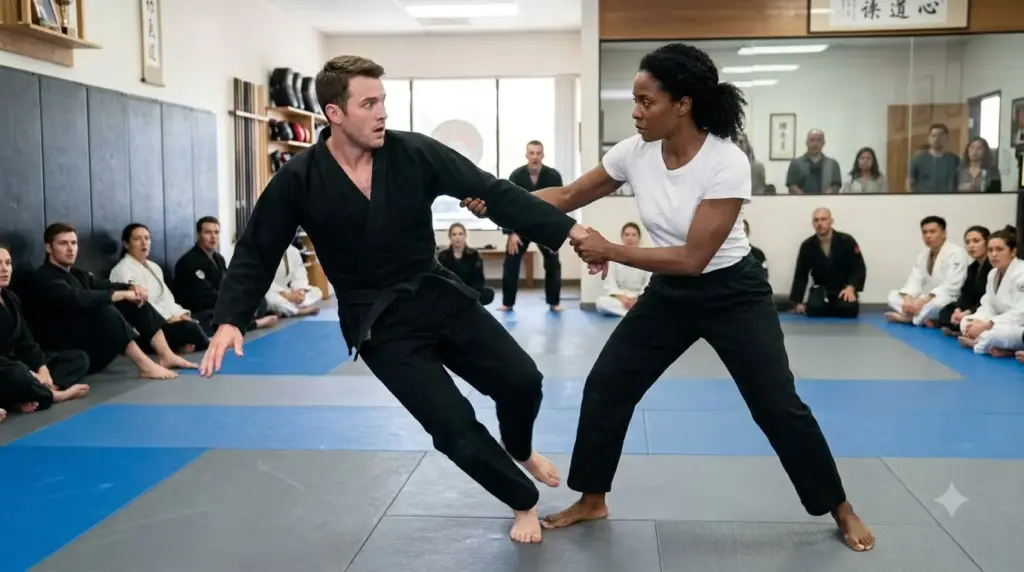
For three full seconds, nobody in the dojo made a sound.
Not the children sitting along the wall.
Not the parents near the glass windows.
Not the assistant instructors in black uniforms.
Not even Coach Daniel Park, who had been walking across the mat when it happened and now stood frozen with one hand still raised, as if his body had tried to stop something his eyes had already seen finish.
Ryan Maddox, the dojo’s loudest black belt, lay flat on his back in the center of the mat.
His right arm was trapped.
His shoulder was controlled.
His breath had left him in one short, shocked grunt.
And the woman he had dared to spar “for fun” was kneeling beside him with one knee lightly near his ribs, one hand on his wrist, and the other controlling his elbow with such quiet precision that every trained adult in the room understood the truth at once.
She could have hurt him.
Badly.
She had chosen not to.
That choice was louder than the throw.
The woman’s name was Claire Bennett.
At least, that was the name she had signed on the visitor waiver.
She was forty-three years old, with dark hair tied back, calm eyes, and a plain white training top without a school patch. No flashy belt. No tournament jacket. No social media camera following her. No announcement.
She had come into Redwood Martial Arts in Sacramento as if she were only another parent, another beginner, another adult trying a trial class because the sign outside said:
Confidence. Discipline. Respect.
Ryan had laughed when she stepped onto the advanced mat.
He had bowed too casually.
He had called her “ma’am” in the tone men use when they want the word to feel like an insult.
Then he had said, “Come on. Just one light round. For fun.”
Claire had said, “No, thank you.”
Ryan had smiled.
The room had smiled with him because it was easier to smile with Ryan than to stand against him.
“Scared?” he asked.
“No,” Claire said.
“Then prove it.”
That was when Coach Park turned from the beginner line and started walking over.
Not fast enough.
Ryan stepped in, reached for Claire’s sleeve, and tried to pull her off balance in front of everybody.
One move later, he was on the mat.
And now the whole dojo understood that the joke had broken in the wrong man’s hands.
Claire released his arm immediately and stood.
She did not raise her voice.
She did not smile.
She did not bow dramatically or look around for approval.
She simply stepped back and said, “You should not grab people who already told you no.”
Ryan rolled onto his side, coughing once.
His face went red.
Not from pain.
From humiliation.
That was more dangerous.
Pain teaches some people caution.
Humiliation teaches others revenge.
Ryan pushed himself to one knee.
“You cheap-shotted me.”
Claire looked at him steadily.
“You touched me after I refused.”
“I was playing.”
“No,” she said. “You were performing.”
That word struck the room harder than it should have.
Performing.
Because everyone knew it was true.
Ryan performed every night.
He performed confidence when new students watched.
He performed toughness when smaller partners tapped.
He performed patience in front of parents, then punished teenagers when the parents left.
He performed humility when Coach Park was watching and cruelty when he was not.
And the dojo had learned to call that leadership because Ryan won medals.
Coach Park finally stepped between them.
“Ryan, sit down.”
Ryan stared at him.
“Coach, she—”
“Sit down.”
The second command was quieter.
That made it worse.
Ryan looked around, searching for support.
His friends near the equipment rack suddenly became very interested in the floor.
A few children looked frightened.
One little girl in a yellow belt whispered, “Is he okay?”
Claire heard that.
So did Coach Park.
Ryan stood anyway.
“I’m fine.”
Coach Park’s eyes hardened.
“I did not ask if you were fine. I told you to sit down.”
For the first time that evening, Ryan obeyed.
He sat near the edge of the mat, breathing through his nose, his jaw tight, his pride bleeding into the room.
Coach Park turned to Claire.
“Ms. Bennett, I apologize.”
Claire nodded once.
“Thank you.”
“I should have stopped him sooner.”
“Yes,” she said.
The honesty landed.
No softening.
No “it’s okay.”
No polite lie.
Just yes.
Coach Park accepted it because he deserved it.
He had built Redwood Martial Arts fifteen years earlier with borrowed mats, secondhand mirrors, and a dream that martial arts could make people gentler, not just stronger. He had taught children how to bow, how to stand still, how to speak clearly, how to fall safely, how to use power only when necessary.
But somewhere along the way, the competition team had become the dojo’s proudest advertisement.
Trophies filled the front shelf.
Parents liked trophies.
Students liked champions.
And Ryan Maddox won.
That was the poison no one wanted to name.
Winning had made Ryan valuable.
Being valuable had made him excusable.
Coach Park had corrected him before.
Small corrections.
Lower your intensity.
Let beginners work.
Do not embarrass the kids.
Release faster.
Stop joking like that.
But Ryan always nodded, smiled, and changed just enough for one class.
Then slowly returned to himself.
That was not correction.
That was maintenance.
Claire had just shown the whole room what maintenance allowed.
A boy named Marcus sat near the wall in a green belt, one arm wrapped around his knees. He had been Ryan’s partner the week before. Ryan had swept him hard during a “demonstration” and laughed when Marcus limped off the mat.
“Don’t be dramatic,” Ryan had said.
Marcus had not returned to advanced class until tonight.
Now he stared at Claire with wide eyes.
Not because she had thrown Ryan.
Because she had refused to pretend Ryan’s behavior was normal.
That meant something to children.
Adults often underestimate how closely children watch who gets protected.





