“Yes.”
“I told myself I was handling it.”
“You weren’t.”
“No.”
He looked back at the mat.
“When he started winning, the parents were proud. The younger students admired him. Other gyms knew his name. I let that matter too much.”
Claire’s voice softened.
“Most schools do. It is easier to display medals than measure trust.”
He nodded.
“Why did you come tonight?”
Claire hesitated.
Then said, “My niece trained here for two weeks.”
Coach Park turned sharply.
“What?”
“Her name is Sophie Bennett. Eleven years old. Yellow belt. She quit last month.”
His face drained.
“Sophie.”
“You remember?”
“Yes. She was quiet. Good focus.”
“She cried in the car after class and told my sister she did not want to come back. She said one of the older boys laughed when she messed up a kick and told her she should try ballet.”
Coach Park closed his eyes.
“Ryan.”
“Yes.”
“Why didn’t your sister call me?”
Claire’s face did not change.
“Because she did not trust that the room would protect Sophie if she complained.”
That answer hurt him.
It was supposed to.
Claire continued.
“Sophie asked me not to come. She was embarrassed. I came anyway because children often blame themselves for rooms adults failed to make safe.”
Coach Park leaned against the doorframe.
“I am sorry.”
“Tell her that. Not me.”
“I will.”
“No,” Claire said. “Write first. Apologies can feel like pressure when adults want forgiveness quickly. Tell her she does not have to answer.”
Coach Park nodded.
“I will.”
The next week was difficult.
That was how Claire knew the change might be real.
Easy changes are usually decoration.
Hard ones require people to lose something.
Redwood Martial Arts lost six students in the first week.
Three were Ryan’s friends.
Two parents said the dojo had become “too sensitive.”
One man wrote an email accusing Coach Park of ruining competitive spirit.
Coach Park saved the email in a folder labeled Culture Review.
Not because it was valuable.
Because he needed reminders of what not to obey.
Ryan did come back.
Not the next day.
Not that week.
Ten days later, he walked in during adult class wearing a hoodie, not his gi. His face looked different without the certainty of the room bending around him.
Coach Park met him near the front desk.
They spoke quietly.
Claire was not there, but Lily later told her what happened.
Ryan wanted reinstatement.
Coach Park said no.
Ryan said he had apologized.
Coach Park said apology was not repair.
Ryan said he was being treated unfairly.
Coach Park said unfairness was when weaker students had to manage his ego in silence.
Ryan threatened to leave permanently.
Coach Park said, “That is your choice.”
Ryan left.
Then came back two days later.
This time, he asked what repair looked like.
That was the first useful question he had asked.
Coach Park gave him conditions.
A written apology to the students, reviewed first by Coach Park.
Thirty days away from sparring.
No competition team for six months.
Mandatory assistant duty in beginner classes, but no physical demonstration without supervision.
Private meetings with Coach Park about leadership and conduct.
And one more condition.
He had to apologize to Sophie Bennett by letter, with no expectation she return.
Ryan hated that one.
Good.
He wrote the first letter badly.
It was full of explanations.
I was joking.
I didn’t mean it.
People misunderstood me.
Coach Park gave it back.
“Again.”
The second letter was shorter but still centered on himself.
I feel terrible.
I’ve lost my place on the team.
This has been hard for me.
Coach Park gave it back.
“Again.”
The third letter finally said:
Sophie,
I made fun of you when you were trying to learn. That was wrong. You were new, and I was supposed to be someone you could feel safe around. Instead, I embarrassed you. I am sorry. You do not have to forgive me or come back. I only wanted to say clearly that it was my fault, not yours.
Ryan
Coach Park sent it to Claire’s sister.
Sophie read it at the kitchen table.
She did not reply.
But she kept the letter.
That was enough for then.
Redwood changed slowly.
At first, students did not trust the new rules.
When Coach Park said students could refuse partners, nobody did.
Choice offered after a long time without safety can feel like a trap.
Then one night, Marcus raised his hand and said he did not want to partner with an older student who always went too fast.
The room froze.
Coach Park nodded.
“Thank you for saying it. Choose another partner.”
No punishment.
No teasing.
No lecture.
The class moved on.
That one moment did more than any poster.
Ava refused a sparring round two days later.
Then a boy named Julian asked for lighter contact.
Then an adult beginner said, “I need to stop,” and everyone stopped immediately.
The room began learning a new reflex.
Not softness.
Clarity.
Claire came back once a month.
She kept her promise of one conversation, then gave more because Sophie was watching the dojo from a distance, deciding whether adults could truly change a place after it had failed her.
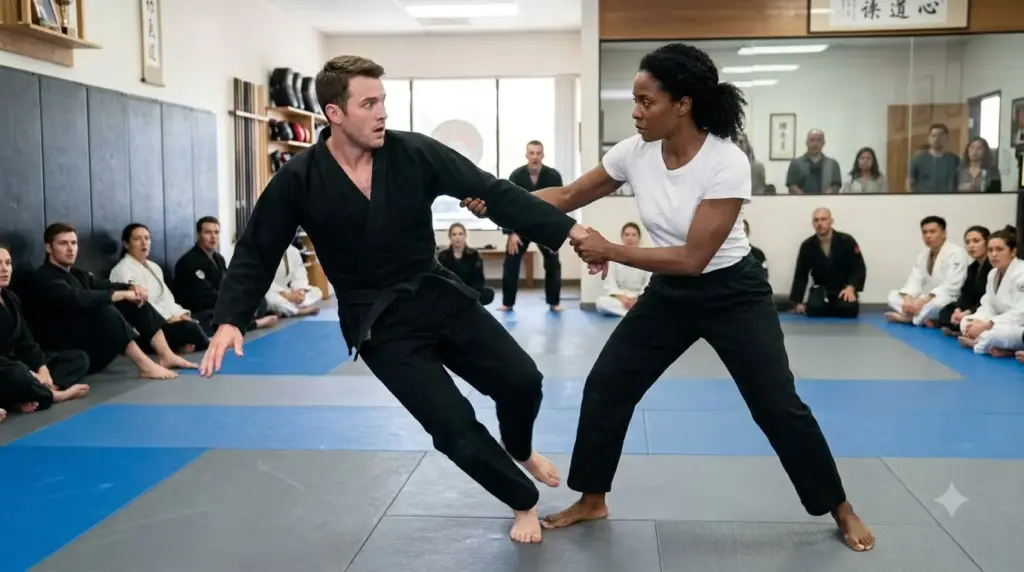
Claire taught a workshop called Control Is Not Weakness.
She had no flashy banner.
No dramatic music.
No tournament highlight reel.
She began by asking students to pair up and practice saying no.
Most laughed nervously.
She waited.
Then she said, “If you cannot say no in practice, you may freeze when it matters. If you cannot hear no in practice, you may become dangerous when it matters.”
The laughter stopped.
They practiced.
No, thank you.
Too much pressure.
Stop.
Not that partner today.
I need a break.
Then they practiced responding.
Okay.
Thank you for telling me.
Let’s reset.
Choose someone else.
Take your time.
It felt strange.
Then it felt useful.
Ryan attended from the back of the room.
He was not allowed to participate physically yet.





