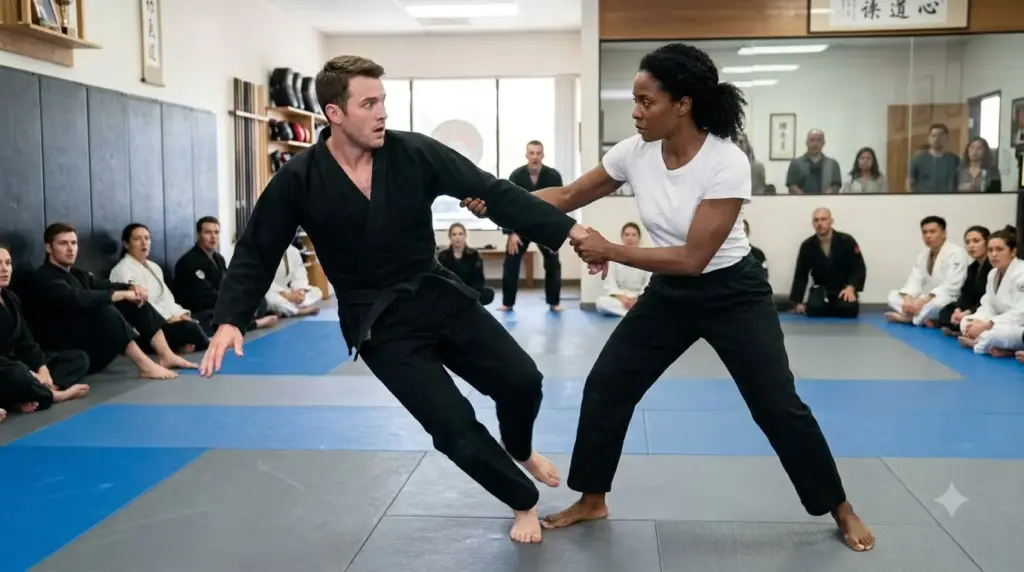
“No. I am finally responding to the pattern I allowed.”
Ryan’s face twisted.
“I bring this place medals.”
“And tonight you showed everyone what they cost.”
That hit Ryan harder than the throw.
His eyes flashed.
“You’ll regret this.”
“No,” Coach Park said. “I already regret waiting.”
Ryan grabbed his gear bag and stormed toward the locker room.
The old version of the dojo might have watched him leave in nervous silence, then slowly returned to training as if nothing had happened.
This time, Coach Park called after him.
“Ryan.”
Ryan turned.
“If you leave angry, leave. But if you come back, you come back as a student, not a star.”
Ryan laughed bitterly.
“I am a black belt.”
Coach Park nodded.
“Yes. That is why you should have known better.”
Ryan had no answer.
He shoved through the locker room door.
It slammed behind him.
A few younger students flinched.
Claire noticed.
So did Coach Park.
He turned back to the class.
“We are done sparring tonight.”
No one objected.
“Parents, you are welcome to stay. Students, we are going to talk.”
For the next hour, the dojo did something it should have done long before.
It listened.
Not to speeches.
To students.
At first, no one wanted to speak.
Then Lily did again.
Then Marcus.
Then Ava.
Then two younger boys.
Then an adult beginner who admitted he had nearly quit after Ryan twisted his wrist too hard and laughed when he tapped.
Stories came out slowly.
Not dramatic stories.
Small ones.
But small humiliations, repeated often enough, become a culture.
Ryan calling kids weak.
Ryan punishing partners who scored on him.
Ryan ignoring taps for half a second too long.
Ryan turning demonstrations into dominance.
Ryan making jokes about girls needing “extra courage” before sparring boys.
Ryan telling smaller students that fear meant they were not serious.
And always, always, the same explanation afterward.
He was joking.
He was intense.
He was preparing them.
He was a champion.
Coach Park wrote nothing down at first.
He only listened.
Then Claire said, “Write it.”
He looked at her.
“Memory will protect you from details you do not want to keep,” she said.
That sentence stung.
He found a notebook.
He wrote.
Every story.
Every name, if the student allowed it.
Every pattern.
Every place where the room had taught children to doubt their own discomfort.
By the time the last student spoke, the evening class should have ended forty minutes earlier.
Nobody moved toward the door.
Coach Park set the notebook on the floor in front of him and bowed his head.
“I am sorry,” he said.
Not to one person.
To all of them.
“I thought discipline meant making students tough enough to handle pressure. I forgot discipline also means controlling the people applying it.”
His voice shook slightly.
“I cannot undo what happened. But I can change what happens next.”
He looked at the assistant instructors.
“From tonight on, every tap ends the exchange immediately. Every no is complete. Every student may refuse a partner without explaining in front of the class. Senior belts will be evaluated not only by skill, but by how safe people feel training with them.”
He looked at the parents.
“I will send a written policy. I will hold a meeting. If your child has had an experience here they did not tell me, I want to know.”
He looked at Claire.
“And I am asking Ms. Bennett, if she is willing, to help us review our training culture.”
Claire raised an eyebrow.
“I do not live in Sacramento.”
“Then even one conversation would help.”
She studied him.
He was not asking for optics.
At least, not only that.
He looked like a man who had realized the building he owned had a crack in the foundation and wanted someone honest enough to point at the part that could fall.
“I can give you one conversation,” Claire said.
“Thank you.”
After class, parents gathered around their children in clusters.
Some whispered.
Some asked questions.
Some looked guilty.
Ava’s father knelt in front of her near the shoe rack.
“I didn’t know,” he said.
Ava shrugged.
“I didn’t want you to make a big deal.”
His face broke.
“It was a big deal if it made you not want to come.”
She looked down.
He hugged her carefully, like he had just learned she had been carrying something fragile.
Marcus approached Claire while she was tying her shoes.
He was thirteen, narrow-shouldered, serious-eyed.
“You’re really good,” he said.
Claire smiled faintly.
“Thank you.”
“Are you a black belt?”
“Yes.”
“In karate?”
“And judo. And jiu-jitsu.”
His eyes widened.
“Why didn’t you say?”
“Would it have made Ryan more respectful?”
Marcus thought about that.
“No.”
“Then it should not have mattered.”
He nodded slowly.
Then asked, “Were you scared?”
Claire looked at him.
She could have said no.
It would have made a better legend.
But children deserve the kind of truth that helps them live, not the kind that makes adults seem untouchable.
“Yes,” she said.
Marcus looked surprised.
“You were?”
“Not of his skill. Of what the room was willing to allow.”
Marcus understood that more than she wished he did.
He looked toward the locker room.
“Do you think he’ll come back?”
“Probably.”
“Will he change?”
“I don’t know.”
“How do you know if someone is really sorry?”
Claire finished tying her shoe and sat back.
“When they stop making their shame more important than the harm they caused.”
Marcus frowned.
“That sounds hard.”
“It is.”
“Have you ever had to do that?”
Claire was quiet for a moment.
“Yes.”
That answer surprised him.
But before he could ask more, his mother called his name.
He bowed awkwardly and ran to her.
Coach Park walked Claire to the front door.
The rain had started outside, thin silver lines under the parking lot lights.
He stood with one hand on the doorframe.
“I knew Ryan was a problem.”
Claire looked at him.





