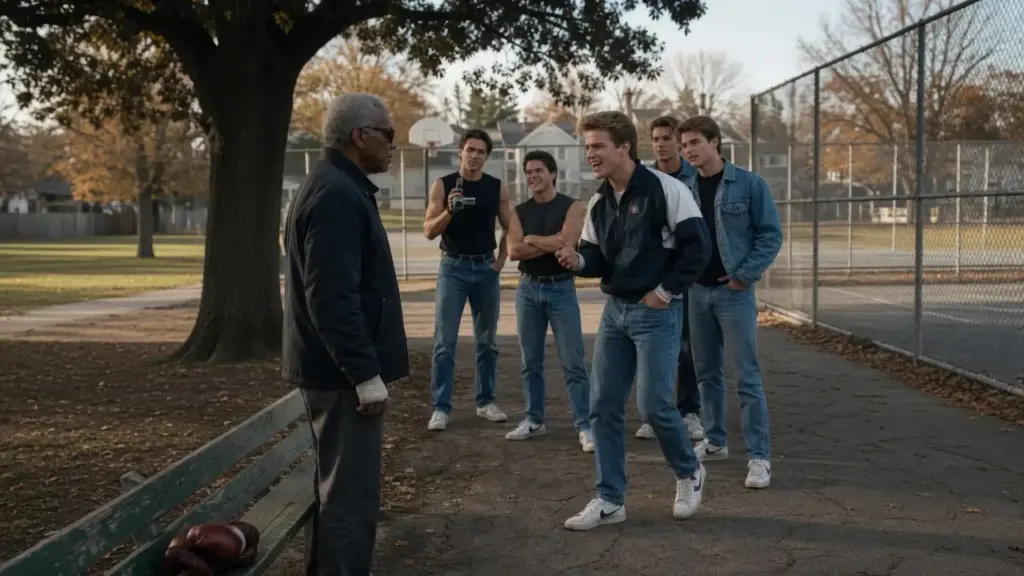
But the voice was different now.
There was no trembling. No patience. No old man.
Brad laughed.
“What are you going to do, Grandpa? Bleed on me?”
He threw a punch.
A lazy, wide right hand. The kind of punch someone throws when he has never been hit back. All arm, no foundation, no guard.
Byron slipped it two inches to the left.
No more.
No less.
The movement was so fast that Brad’s fist hit nothing but air. His momentum carried him forward, off balance.
His eyes went wide.
That was the first time fear touched his face.
Byron’s left jab landed before Brad could reset.
Straight down the center.
Clean.
The sound was sharp. Not a thud, a crack.
Brad’s head snapped back. His nose shifted half an inch to the right.
Brad staggered and put his hands up.
Too late.
Too high.
Byron’s right cross came underneath into the solar plexus.
Every molecule of air left Brad’s lungs in one sound. His mouth opened. Nothing came out.
Then came the uppercut.
Byron planted his back foot, rotated his hips the way Curtis Holloway had taught him in the basement in Philadelphia, and drove his right fist upward from his waist.
It connected under Brad’s chin with the precision of a man who had thrown that exact punch ten thousand times, in the ring, in the garage, in his sleep.
Brad Sawyer left the ground.
Both feet.
Just for a second.
Then he hit the concrete face first and did not move.
Three punches.
Five seconds.
Forty-six years of silence broken in five seconds.
The park was quiet.
Sixteen thousand people on the stream were quiet.
Brad’s friends were quiet.
The one with the ring light had not moved. The phone was still recording.
Byron stood over Brad. His hands were shaking now, not from exhaustion, but from the flood of something he had spent thirty years trying to bury.
He looked at his fists.
Opened them.
Closed them.
Opened them again.
Then he turned around, walked to Caleb, and knelt down.
He pressed his palm against the cut on the boy’s forehead.
Gentle.
The same hands that had just put a twenty-two-year-old on the ground were now holding a ten-year-old’s face like it was made of glass.
“You okay?” he asked.
Caleb nodded. His eyes were wide, but not afraid.
Something else.
“Mr. Byron,” he whispered. “You can fight.”
Byron picked the boy up, set him on the bench, and wrapped his forehead with the old hand wraps from the canvas bag. Then he sat beside him and put his arm around his shoulders.
He did not say anything.
There was nothing to say.
Across the park, Brad Sawyer was being helped to his feet by his friends. His nose was bleeding. His jaw hung slightly open on the left side.
The ring light was still on.
The stream had been recording the entire time.
Twenty-two minutes of footage.
The clip of the three punches was extracted within the hour. By noon, it had four million views. By the next morning, forty million.
The comments came in waves.
Who is this old man?
That footwork, that’s not a street fighter.
Somebody ID this guy.
The hashtag started small.
#ParkKnockout.
But by evening, it had been replaced by something else.
Something that would change everything.
#BlindChampion.
And somewhere in a living room across town, a sixty-eight-year-old retired sports journalist named Gene Whitfield watched the clip for the eleventh time.
He paused it at the uppercut.
Zoomed in on the footwork.
The pivot.
The hip rotation.
He knew that technique.
He had seen it before, thirty years ago, in a ring from a fighter they called the Ghost.
Gene Whitfield picked up his phone.
Councilman Garrett Sawyer saw the video at nine o’clock on Saturday morning. His chief of staff sent it with one line.
This is your son.
Garrett watched it twice. Then he closed his office door and made four phone calls.
The first was to the police chief, a man who owed his appointment to Garrett’s endorsement. The second was to the district attorney’s office. The third was to a media consultant who had managed three of his campaigns. The fourth was to his personal attorney.
By Sunday evening, Byron Ingram had been charged with aggravated assault.
The arrest happened at six o’clock Monday morning.
Two officers knocked on Byron’s door. He opened it in the same clothes he wore to the park. Canvas jacket. Dark glasses. The bag of gloves sitting by the door, ready for the morning session.
“Mr. Ingram, you’re under arrest for the assault of Brad Sawyer.”
Byron did not resist.
He set the bag down on the porch, took off his glasses, and held out his wrists.
Mrs. Patterson was watching from her window. She saw them put the handcuffs on a seventy-four-year-old man at sunrise.
She called her daughter and cried for twenty minutes.
Garrett Sawyer held a press conference that afternoon.
Suit pressed. American flag pin on his lapel. He stood behind the podium at city hall with Brad beside him, jaw wired shut, neck brace, arm in a sling.
The camera loved it.
A father protecting his injured son.
The image was perfect.
“My son was violently attacked by an unhinged individual in a public park,” Garrett said. “Brad is twenty-two years old. He suffered a broken nose, a dislocated jaw, and a concussion. This was not self-defense. This was a brutal, unprovoked assault by someone who clearly has a history of violence.”
He paused, looked down at his notes, then looked back up with practiced grief.
“I’m asking the DA to pursue the maximum sentence. No one, regardless of age, has the right to put their hands on another person. We are a city of laws.”
No reporter asked about Caleb.
No reporter asked about the twenty minutes of harassment that preceded the three punches.
Garrett’s media consultant had sent the press a carefully edited clip, ninety seconds long, starting the moment Byron took off his glasses.





