“No,” Byron said. “My TV’s been off since Monday.”
“The charges are being dropped. The DA just announced it, and the AG is looking into the councilman. All of it. The underground fights, the sealed complaint, the obstruction, everything.”
Byron was quiet for a long time.
“Mr. Ingram, are you there?”
“I’m here,” he said. “Is it safe to go back to the park?”
Sarah laughed.
It was the first time she had laughed in weeks.
“Yes,” she said. “It’s safe.”
Byron hung up the phone.
He walked to the front door and picked up the canvas bag.
The gloves were inside. Cracked leather. Frayed laces. Thirty years of silence stitched into every seam.
He walked to the porch, looked at the cardboard still taped over the broken window, and then looked at Helen’s roses.
Blooming late this year.
But blooming all the same.
Then he called Caleb’s grandmother.
“Tell him to meet me at the park tomorrow. Seven o’clock. Under the oak tree.”
The investigation moved fast, faster than anyone expected.
The state attorney general’s office subpoenaed Garrett Sawyer’s financial records on Monday. By Wednesday, they had the shell company filings, the warehouse lease, and the bank statements showing cash payments to unlicensed fighters between 1982 and 1984.
Fourteen fighters.
No medical coverage. No insurance. No records filed with the State Boxing Commission.
Three of those fighters had suffered career-ending injuries.
Byron was one of them.
The other two had never come forward.
On Thursday, Garrett Sawyer was formally charged with racketeering, operating an unlicensed sporting event, and obstruction of justice, the last one for the two police complaints about Brad that had been buried.
The sealed complaint from 1984 was unsealed.
His name was on every page.
Garrett held no press conference this time.
No American flag pin.
No podium.
His attorney released a two-sentence statement.
Councilman Sawyer denies all charges and looks forward to his day in court.
By Friday, he had resigned from the city council.
Not voluntarily.
The council voted unanimously to remove him.
The man who had sat in the chair of public safety for three terms was escorted out of city hall by the same officers who had once buried complaints on his behalf.
Brad Sawyer was charged separately.
Assault on a minor for shoving Caleb. Harassment. Criminal mischief for the spray paint and property damage.
His TikTok account was suspended. His two hundred thousand followers watched his last video, the live stream from the park, get taken down by the platform.
The comments section before it disappeared was nothing but #BlindChampion and #JusticeForByron.
Brad’s friends were charged as accessories.
The one with the ring light deleted his account.
It did not matter.
The footage was already everywhere.
The boxing community found Byron before the courts did.
It started with a phone call from the World Boxing Association. Then the International Boxing Hall of Fame. Then fighters active and retired who had grown up hearing whispers about the Ghost.
The middleweight who vanished.
The champion with no farewell fight.
They had all watched the Brandon Park clip. They had all read Gene Whitfield’s article. And they all wanted the same thing.
To acknowledge what had been stolen.
The WBA issued a formal statement recognizing Byron “the Ghost” Ingram’s career record. Twenty-three fights. Twenty-three wins. Fifteen knockouts.
The statement condemned the circumstances that had ended his career and called the underground bout a criminal act that robbed the sport of one of its finest competitors.
Three former middleweight champions recorded video messages. One of them, Carlos Rivera, who had held the belt two years after Byron lost his eye, said something that went viral on its own.
“I always wondered who the Ghost was. Now I know, and I wish I could have fought him. I think he would have beaten me.”
Gene Whitfield published a follow-up piece the next week.
This one was different.
No investigation. No records.
Just a profile.
He spent a morning on Byron’s porch, watching him teach Caleb. The canvas bag sat between them. The old gloves rested on the railing.
“Do you feel vindicated?” Gene asked.
Byron thought about it.
“I feel tired,” he said. “But the good kind.”
The neighbors came back first.
Mrs. Patterson brought a casserole and an apology. She stood on Byron’s porch with tears running down her face.
“I should have called,” she said. “I should have done something.”
Byron took the casserole.
“You’re here now,” he said. “That counts.”
Deshawn’s mother brought him back to the group.
So did Kesha’s father.
Within a week, Byron had nine kids showing up every morning.
Then twelve.
Then fifteen.
Parents started staying to watch. Some of them brought chairs. One brought a folding table with water bottles and orange slices like it was a real gym.
The city council, now missing one member, passed a resolution the following month. Brandon Park would receive funding for a permanent community boxing program.
New equipment. A covered training area near the oak tree. Licensed coaches. Free for all kids under sixteen.
They asked Byron what to name it.
He did not hesitate.
“The Helen Ingram Boxing Program,” he said. “After my wife. She’s the reason I kept my hands down for thirty years. And she’s the reason I finally put them back up.”
Byron Ingram walked back into Brandon Park on a Tuesday morning in November.
Seven o’clock sharp.
Canvas bag over his shoulder.
Dark glasses on, new ones paid for by a boxing fan in Detroit who had mailed them with a handwritten note.
For the Ghost. Welcome back.
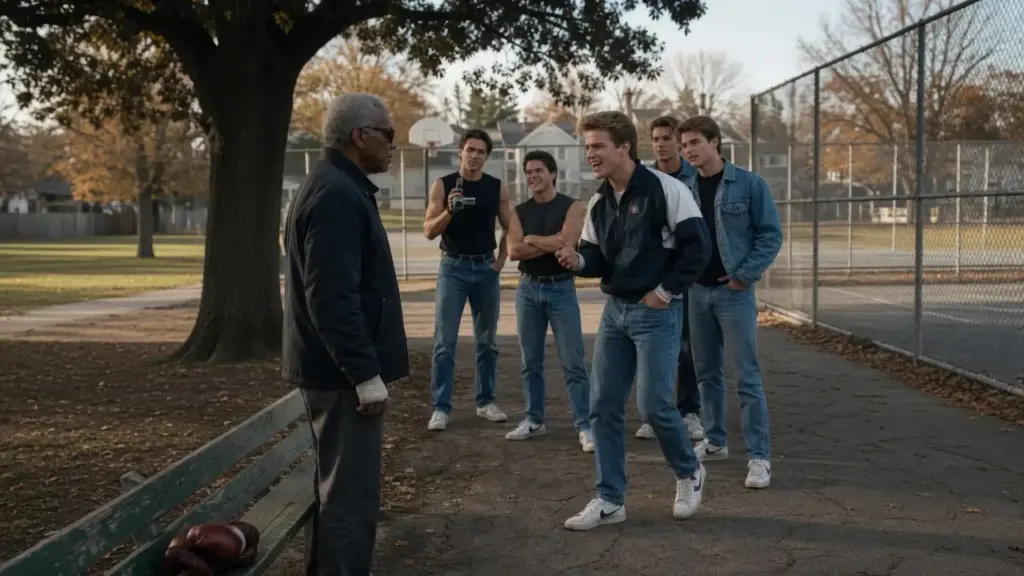
Caleb was already there, sitting on the bench under the oak tree, hands wrapped, fists up, waiting.
Byron set the bag down and looked at the bench.
The spray paint was gone. Someone had sanded it clean and repainted it. A small brass plaque had been screwed into the backrest.
It read, This bench belongs to Byron Ingram and everyone he teaches.
He did not know who put it there.





