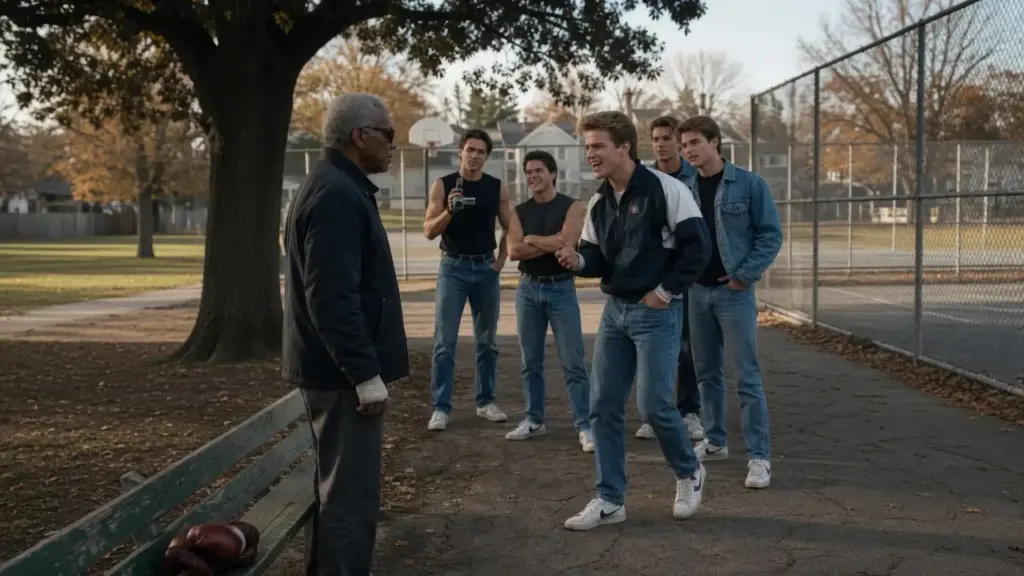
Everything before that had been cut.
The narrative was set.
Cable news ran the clip with a new headline.
Elderly man viciously attacks youth in park.
They slowed down the uppercut. They zoomed in on Brad hitting the concrete. They showed Brad’s hospital photo, swollen face, neck brace, tubes.
One anchor called Byron a ticking time bomb hiding in a public space.
They did not show Caleb. They did not mention the blood on a ten-year-old’s forehead. They did not play the first twenty minutes of the stream where Brad harassed, humiliated, and shoved a child.
That part of the footage had been quietly filed as unverified by the Sawyer legal team.
The comment sections turned.
Not all of them.
But enough.
That old man could have killed him.
There’s no excuse for that level of violence.
He needs to be in a facility.
Why was he even around children?
The people who had cheered #BlindChampion on Friday were now sharing concern pieces by Monday.
A petition appeared online.
Remove dangerous individuals from Brandon Park.
It had eight hundred signatures by Tuesday.
Byron was released on bail Tuesday morning.
His public defender, a young woman named Sarah Collins, had forty-three active cases and a desk covered in folders. She told him the situation was serious.
“The DA is pushing for felony assault,” Sarah said. “Councilman Sawyer is pressuring the judge. They want to make an example.”
“An example of what?” Byron asked.
“Of you,” she said. “They’re saying you’re dangerous. That you used trained fighting skills against an unarmed person. That makes it aggravated.”
Byron sat in her office and said nothing for a long time.
Then he asked, “What about the boy? What about what Brad did to Caleb?”
Sarah looked at her desk.
“The Sawyer family hasn’t been charged with anything. Brad’s statement says he was trying to mediate a dispute when you attacked him without warning.”
“That’s a lie.”
“I know. But they have a councilman, a media team, and a DA who plays golf with Garrett Sawyer every Thursday. We have a viral video that half the country now thinks shows an old man beating up a kid.”
“He’s twenty-two.”
“On camera with the neck brace, he looks eighteen. That’s all that matters.”
A restraining order was filed Wednesday.
Byron was prohibited from going within five hundred feet of Brandon Park. The order was signed by Judge Mitchell Crane, the same judge who had attended Garrett Sawyer’s fundraiser dinner three months earlier.
That evening, someone threw a rock through Byron’s front window.
No note. No face. Just a fist-sized hole in the glass and shards on Helen’s rug.
Byron swept them up in silence. He taped a piece of cardboard over the hole and sat on the couch in the dark.
He could not go to the park. He could not see Caleb. He could not do the only thing that had given his mornings meaning since Helen died.
The canvas bag sat by the door like a promise he could no longer keep.
Caleb’s grandmother called that night. Her voice was thin.
“Mr. Ingram, I don’t know what to do. Caleb won’t eat. He won’t talk. He just sits by the window and looks at the park. He wrapped his own hands this morning. Just sat there with his fists up, hitting the air.”
“Tell him I’ll be back,” Byron said.
“When?”
Byron did not answer.
He did not know.
The next morning, Byron woke at seven o’clock out of habit. He got dressed, picked up the bag, walked to the front door, stopped, set the bag down, and sat on the porch.
He did the same thing the next morning.
And the next.
And the next.
On the fourth morning, he found Caleb sitting on his front steps.
The boy had walked eleven blocks alone before sunrise to find him. His hands were already wrapped badly, lopsided, the tape bunching between his fingers.
The way a ten-year-old wraps his own hands when his coach is not there.
“Mr. Byron,” Caleb said, “I don’t want to stop.”
Byron looked at the boy. His split lip was still healing. There were dark circles under his eyes.
But his fists were up.
Guard position.
Protecting what matters.
Byron knelt down, unwrapped the boy’s hands, and rewrapped them properly.
Two loops around the wrist.
Three across the knuckles.
Pulled tight between each finger.
Curtis Holloway’s method.
The same way he had been doing it for fifty years.
“We’re not stopping,” he said.
They trained on Byron’s porch that morning.
No oak tree. No cracked concrete ring. No canvas bag of gear.
Just an old man and a boy and a pair of gloves that had survived everything the world had thrown at them.
Gene Whitfield had covered boxing for forty-one years. Ringside at the Garden. Press row at Atlantic City. He had watched four hundred professional fights in person and written about three hundred of them.
He knew fighters the way a piano tuner knows pianos, not by looking at them, but by listening to the way they moved.
He watched the Brandon Park clip for the fourteenth time on a Wednesday evening.
His wife asked him to come to dinner.
He did not hear her.
It was the uppercut that haunted him.
Not the power, though the power was real.
It was the setup.
The way the old man planted his back foot at exactly forty-five degrees. The way his hips rotated before his arm moved. The way the fist traveled from the waist, not the shoulder.
That was not a street fighter’s uppercut.
That was a trained technique.
A specific technique.
One he had seen exactly once before in his career.
Atlantic City, 1984.
Middleweight title fight.
A fighter they called the Ghost.
Gene pulled up his archive. Forty-one years of notes, photos, fight cards, and press clippings, all stored in filing cabinets in his basement.
He found the folder in twenty minutes.
Byron “the Ghost” Ingram.





